


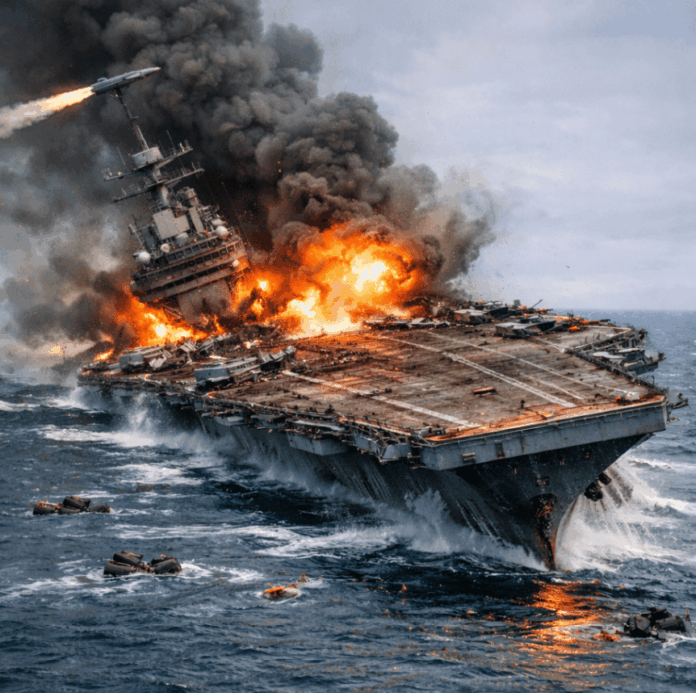
In modern conflicts, the first explosions are not always those of missiles. More often than not, they erupt first across social media feeds — through striking videos, dramatic images and viral narratives that travel faster than any military confirmation. The recent episode surrounding the alleged destruction of a U.S. aircraft carrier in the Persian Gulf illustrates this phenomenon perfectly. Within hours, the claim that the USS Abraham Lincoln had been struck by Iranian missiles spread across millions of screens, despite the absence of any verifiable evidence. The story reveals, once again, the growing role of war-time misinformation in contemporary conflicts.
Iran’s announcement and the start of the information fog
On March 1, Iran’s Revolutionary Guards released a statement claiming they had struck the American aircraft carrier USS Abraham Lincoln with several ballistic missiles in the Persian Gulf. The tone of the message was combative, almost theatrical. According to Iranian state media relaying the statement, U.S. forces had allegedly suffered significant losses and the sea would soon become “the graveyard of aggressors.”
In an already tense regional climate following U.S. and Israeli strikes against Iran just days earlier, the claim quickly ignited reactions online.
Washington responded within hours. U.S. Central Command (CENTCOM), responsible for American military operations in the Middle East, firmly denied that the aircraft carrier had been hit. According to the American military, the missiles launched were fired from far away and posed no direct threat to the carrier strike group, which continued normal flight operations.
But by that point, the informational damage had already begun.
Within hours, a flood of dramatic images started circulating across social media platforms.
Spectacular images… but completely fake
Several videos showing a warship engulfed in flames quickly spread across X, Facebook and TikTok. Some of these clips gathered millions of views in a matter of hours. The accompanying captions were unequivocal: proof that the USS Lincoln had been destroyed by Iranian missiles.
In reality, none of these images had anything to do with the current conflict.
Some of the footage had already circulated months earlier, particularly during the brief confrontation between Israel and Iran in 2025. Other clips originated from military simulations or video games, notably the well-known military simulator Arma 3, whose highly realistic graphics have repeatedly been repurposed in disinformation campaigns.
This phenomenon is far from new. Over the past few years, footage from video games has repeatedly been presented online as real battlefield evidence — supposed air strikes, naval attacks or missile interceptions.
Each time, the mechanism is similar: a visually striking clip, a misleading caption, and rapid viral distribution long before any fact-checking can catch up.
Information warfare as a modern battlefield
The episode surrounding the USS Lincoln highlights a broader geopolitical reality: war today is fought not only with weapons but also with narratives.
Images, stories and perceptions have become strategic tools capable of influencing international public opinion, destabilizing political narratives and shaping the perceived balance of power.
Some states have developed considerable expertise in this field.
Russia, in particular, is often cited as one of the most advanced actors in information warfare. Over the past decade, several influence campaigns attributed to Moscow have been observed across Europe and the United States, especially during major elections or geopolitical crises.
The war in Ukraine has further reinforced this perception. Western intelligence services have repeatedly accused Russian networks of spreading manipulated images, amplifying misleading narratives or flooding the information space with contradictory claims designed to blur the truth.
Within this context, some analysts consider it plausible that pro-Russian networks may occasionally amplify or relay certain narratives originating elsewhere, especially when those narratives contribute to undermining Western credibility. In modern propaganda strategy, the objective is not always to convince everyone. Often, it is simply to introduce doubt, overwhelm the information space and make objective truth harder to identify.
A familiar pattern of wartime misinformation
The aircraft carrier rumor fits into a broader pattern seen repeatedly in recent conflicts.
Since the beginning of the current Middle Eastern tensions, multiple misleading visuals have circulated online: old footage of naval explosions reused as evidence of new attacks, videos from military exercises presented as real combat operations, or digital simulations falsely labeled as proof of battlefield victories.
Similar waves of misinformation appeared during the war in Ukraine, the Nagorno-Karabakh conflict, and several previous military crises in the region.
Every major geopolitical confrontation now seems to generate its own parallel war of images.
A U.S. aircraft carrier is not an easy target
Beyond the information battle, the military reality is far less dramatic than the viral narratives suggest.
Striking a U.S. aircraft carrier is an extraordinarily complex operation. The USS Abraham Lincoln never operates alone. It travels within a carrier strike group composed of destroyers, missile defense systems and advanced surveillance assets.
Together, these systems create a protective perimeter capable of detecting and intercepting threats hundreds of kilometers away.
In other words, the idea that a few missiles could suddenly destroy an American aircraft carrier belongs more to the realm of propaganda and psychological warfare than to realistic military strategy.
Truth, the first casualty of war
Ultimately, the story of the USS Lincoln illustrates a deeper transformation in the nature of modern conflict.
Battles are no longer fought solely on land, at sea or in the air. They are fought across digital networks, in algorithm-driven timelines and in the perceptions of global audiences.
In this environment, wartime fake news has become a weapon in its own right — capable of shaping narratives, influencing opinions and destabilizing adversaries without firing a single shot.
And in this dense informational fog, where propaganda, speculation and manipulation intertwine, one reality remains constant.
The first casualty of war is still the truth.

