


Washington claims progress. The region, as always, hesitates between tactical pause and strategic deception.
In the carefully staged corridors of American diplomacy, Israel Lebanon direct negotiations are presented as a breakthrough—almost an overdue normalization between two states technically at war since 1948. Yet the choreography itself raises questions: who benefits from this sudden acceleration, and why now, when the ground reality remains saturated with unresolved tensions, proxy forces, and competing sovereignties?
Israel Lebanon direct negotiations: a diplomatic theatre orchestrated in Washington
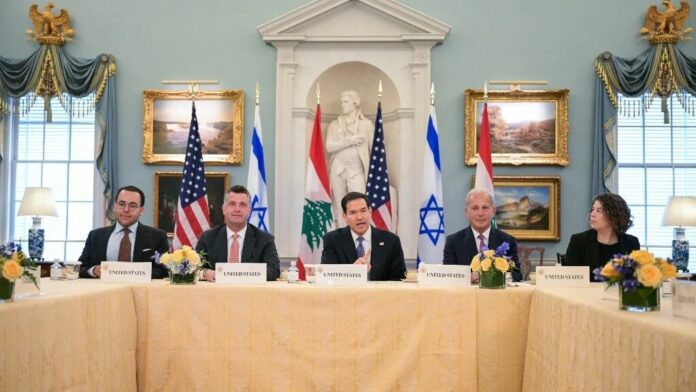
The announcement came, predictably, from Washington. After what officials described as “productive discussions,” Israeli and Lebanese representatives agreed in principle to enter direct negotiations—a formulation that, in diplomatic language, often masks the absence of substance.
The meeting, held under the supervision of U.S. Secretary of State Marco Rubio, brought together ambassadors from both sides—an event framed as “historic,” the first of its kind since 1993. But history, in the Levant, has a habit of repeating itself not as progress, but as stagnation wrapped in new vocabulary.
Washington insists these talks could evolve beyond the limited framework of the 2024 arrangements toward a “comprehensive peace agreement.” Such ambition would be credible if the underlying power dynamics had changed. They have not.
The United States reaffirmed its unwavering support for Israel’s “right to defend itself”—a phrase that, in practice, continues to legitimize asymmetric military actions while ignoring the structural fragility of the Lebanese state.
Signals behind the announcement: what is not being said
The language of optimism contrasts sharply with the signals on the ground.
Lebanon remains fragmented, its sovereignty diluted by internal divisions and the enduring influence of Hezbollah—an actor that is conspicuously absent from official negotiation frameworks yet central to any real balance of power.
At the same time, Washington’s insistence that any ceasefire or agreement must occur strictly “between governments” is not a procedural detail—it is a strategic move to exclude Iran’s indirect leverage. This reveals the true objective: not peace, but containment.
Financial markets, regional airspace monitoring, and military postures all suggest a pause, not a resolution. In such contexts, diplomacy often functions less as a solution than as a holding pattern before the next escalation.
France sidelined: a revealing diplomatic fracture
Perhaps the most telling moment came not from the negotiations themselves, but from Israel’s unusually blunt dismissal of France.
The Israeli ambassador in Washington openly rejected any French involvement, stating that Paris should be kept “as far away as possible” from the process. Such language is not accidental—it reflects a deeper recalibration of influence in the region.
France, historically embedded in Lebanon’s political and cultural fabric, now finds itself excluded from a process dominated by Anglo-American priorities. Its calls to integrate the Lebanese front into broader ceasefire frameworks—particularly those involving Iran—have clearly irritated Israeli leadership.
This exclusion signals a broader shift: Middle Eastern diplomacy is increasingly centralized around Washington, with European actors relegated to symbolic roles.
A controlled narrative, not yet a peace process
The framing of these talks as an “historic step” deserves scrutiny. Diplomacy, especially in this region, thrives on announcements that precede reality.
The core issues remain untouched:
- Hezbollah’s military autonomy
- Israel’s security doctrine based on preemptive force
- Lebanon’s institutional weakness
- Iran’s strategic depth in the Levant
None of these are resolved at a negotiating table in Washington.
The emphasis on Israel Lebanon direct negotiations serves, above all, a narrative purpose: to signal progress, stabilize perceptions, and buy time. Whether that time leads to de-escalation or merely prepares the next confrontation remains an open question.
Between illusion and calculation
There is, undeniably, a shift—but it is procedural, not structural. The region is not moving toward peace; it is adjusting its posture.
What Washington presents as a diplomatic opening may well be a tactical maneuver, designed to reassert control over a fragmented geopolitical landscape. Israel consolidates its strategic freedom, Lebanon is urged toward internal normalization, and external actors are quietly pushed aside.
In the end, these negotiations may prove less about reconciliation than about redefining the terms of the next crisis—calmer in appearance, but no less inevitable.

