


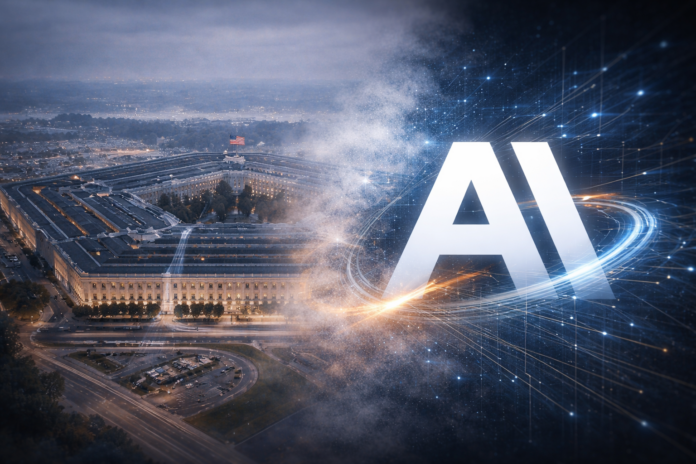
Something unusual is unfolding in the discreet but decisive corridors where Silicon Valley meets the American national security apparatus. The Anthropic US government conflict has moved from quiet bureaucratic tension to open legal warfare after the artificial intelligence startup filed a lawsuit against several U.S. federal agencies.
Officially, the dispute revolves around “national security procurement risks.” Unofficially, the episode reveals a far more uncomfortable reality: Washington’s growing impatience with private companies that refuse to fully align with military priorities. When a government accustomed to technological dominance meets a firm invoking ethical limits, friction was perhaps inevitable.
And yet, beyond the public rhetoric, the signals coming from the markets, the tech ecosystem, and the Pentagon itself suggest something deeper — a strategic power struggle over who ultimately controls the future of artificial intelligence.
The Pentagon’s Sanctions and the Birth of the Anthropic US Government Conflict
The confrontation escalated last week when the U.S. Department of Defense placed Anthropic on a blacklist reserved for entities deemed to pose a “national security supply risk.”
Until now, such lists had largely been populated by foreign adversaries — Chinese telecom giant Huawei or Russian cybersecurity firm Kaspersky. Seeing an American AI company suddenly included among them immediately raised eyebrows across the technology sector.
The decision followed a blunt order from President Donald Trump demanding that all federal agencies immediately cease using Anthropic’s AI systems, particularly its Claude model.
The justification from Washington was direct: Anthropic had refused to remove certain restrictions on how its artificial intelligence could be used by the U.S. military.
Among those restrictions:
- Refusal to enable mass domestic surveillance
- Limits on fully autonomous lethal weapons
- Mandatory human oversight in military decision-making
To the Pentagon, these conditions were seen as ideological obstacles to operational efficiency. To Anthropic, they were non-negotiable guardrails.
The resulting Anthropic US government conflict was therefore not simply regulatory. It was philosophical.
Silicon Valley Divided: OpenAI Steps In
In a move that did not escape observers of the tech-defense ecosystem, the Pentagon simultaneously finalized a cooperation agreement with OpenAI, the company behind ChatGPT.
OpenAI CEO Sam Altman announced that his company would deploy AI models inside classified U.S. defense networks, while claiming the deal still respected certain ethical limits.
Yet those “limits” appeared strikingly similar to the ones that had triggered Washington’s clash with Anthropic.
The contrast raises a troubling question:
Why was one company sanctioned while another was welcomed?
The answer likely lies not in ethics but in institutional trust and political alignment. Washington tends to favor partners willing to negotiate quietly rather than confront policy decisions publicly — and Anthropic, by refusing to bend, crossed a line rarely challenged inside the American national security ecosystem.
Anthropic’s Legal Counterattack
Anthropic’s lawsuit, filed in a California federal court, describes the sanctions as “unprecedented and illegal.”
According to the company, the U.S. government is abusing its regulatory power to punish a firm for exercising its freedom of expression and ethical autonomy.
The legal argument rests on three key points:
- The blacklist designation is arbitrary and politically motivated
- The sanctions threaten the company’s commercial viability
- The government cannot coerce private firms into removing ethical safeguards
In the complaint, Anthropic even accuses Washington of attempting to “destroy the company.”
Such language is rare in disputes between Silicon Valley and federal agencies, which are usually resolved quietly through lobbying or regulatory compromise.
The open confrontation signals a deeper rupture.
A Quiet Support Network Inside Big Tech
Interestingly, the conflict has not left Anthropic isolated.
Thirty-seven engineers and researchers from both Google DeepMind and OpenAI submitted a legal brief supporting the startup’s position. Their argument is simple: penalizing a major American AI firm for ethical restrictions could undermine U.S. technological leadership.
Behind this support lies a broader anxiety spreading across the tech sector.
If Washington can blacklist an American company for refusing military demands, then every AI developer must now consider a difficult question:
Are ethical red lines compatible with national security expectations?
Or will they eventually be treated as obstacles to be eliminated?
The Strategic Stakes Behind the AI Power Struggle
Seen from a geopolitical perspective, the Anthropic US government conflict reflects a deeper transformation in the global balance of technological power.
Artificial intelligence is no longer merely a commercial technology. It has become:
- a military multiplier
- an economic weapon
- and potentially the backbone of future surveillance states.
For the United States, maintaining dominance in AI is now a strategic imperative comparable to nuclear supremacy during the Cold War.
From that perspective, Anthropic’s resistance appears less like corporate ethics and more like a structural challenge to state authority.
And states — especially superpowers — rarely tolerate such challenges for long.
Silicon Valley’s Illusion of Independence
The lawsuit filed by Anthropic may last months or even years, but the underlying lesson is already clear.
Silicon Valley has long cultivated the image of an autonomous technological frontier, guided by innovation and moral reflection. Yet the moment those principles collide with national security imperatives, the illusion quickly fades.
In the emerging era of AI geopolitics, neutrality is becoming impossible.
Companies will eventually face a stark choice:
align with the strategic objectives of their governments — or confront them in court, as Anthropic has now chosen to do.
History suggests that when technology meets state power, the state rarely retreats.
And the Anthropic US government conflict may only be the first visible fracture in what could become a far larger struggle over who truly controls the future of artificial intelligence.

