


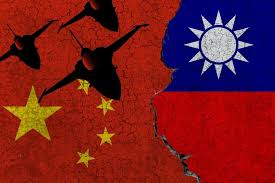
A war that clarifies more than it resolves
There is something deceptively chaotic about the current U.S. strike on Iran, yet beneath the noise—media outrage, diplomatic tremors, fluctuating oil charts—a colder logic is taking shape, one that says less about Tehran than it does about Beijing, and perhaps even more about the narrowing strategic margin available to Taiwan.
Operation Epic Fury, already sliding into a war of attrition, has been framed in familiar terms: another American overreach, another Middle Eastern entanglement destined to erode credibility. The commentary is predictable, almost ritualistic. But this reading, while comfortable, misses the essential point. Washington may not be seeking victory in the classical sense at all.
If anything, the pattern—already visible during Trump’s earlier tenure—is reasserting itself with unsettling clarity: destruction over reconstruction, disruption over stability, exit over ownership. The objective is not to win cleanly, but to leave the battlefield strategically altered, even if politically ambiguous.
And it is precisely in that ambiguity that the real message is being sent—to China.
The strategic signal to China behind the US strike on Iran
The US strike on Iran is not merely a regional intervention; it is a systemic stress test imposed on China’s geopolitical posture.
For years, Beijing has cultivated an image of itself as a restrained alternative to American interventionism—a power that offers economic partnership without military entanglement. This narrative, carefully maintained through initiatives and diplomatic positioning, now encounters a brutal reality check.
When Iran—arguably one of China’s most symbolically important partners—comes under sustained U.S. military pressure, Beijing’s response remains conspicuously limited to rhetoric. No material deterrence, no meaningful projection of force, no credible security guarantee.
This silence is not incidental. It is structural.
China’s model was never designed for hard security commitments; it thrives in zones of economic dependency, not kinetic confrontation. The Iranian theater exposes this limitation in full daylight.
At the same time, the material consequences are not negligible. With strikes on infrastructure such as Kharg Island and parallel pressure on regimes like Venezuela, a significant portion of China’s external energy buffer is being quietly degraded. Not collapsed—yet—but undeniably weakened.
And still, the Strait of Hormuz remains open, Chinese tankers continue to pass. Which only reinforces the deeper point: the real damage is not logistical, but reputational.
China’s “great power” image is not shattered overnight—but it is eroding, slowly, perceptibly, perhaps irreversibly.
Taiwan’s strategic dilemma in an age of flexible realism
For Taiwan, the implications of the US strike on Iran are neither abstract nor distant. They cut directly into the island’s strategic calculus.
The past decade offered Taipei a relatively comfortable narrative framework: democracy as shield, international visibility as deterrence, alignment with Washington as implicit security guarantee. That framework is now fraying.
Under what might be called “Trump 2.0,” the United States appears less interested in ideological coalitions and more inclined toward transactional, interest-driven engagements—what could be described, without illusion, as flexible realism.
This shift introduces both risk and opportunity.
On one hand, Taiwan is no longer automatically elevated as a symbolic frontline of democracy. On the other, it gains something arguably more valuable: strategic ambiguity.
By refusing to consistently center Taiwan in U.S.-China discourse, Washington complicates Beijing’s planning. Uncertainty, in this context, becomes a form of deterrence. Not elegant, not reassuring—but effective.
Yet this also imposes a burden on Taipei.
Taiwan can no longer rely primarily on ideological alignment. It must justify its importance in functional terms—industrial, logistical, strategic. Semiconductor dominance is part of this equation, but insufficient on its own.
What matters now is integration into a broader security architecture:
- safeguarding maritime routes in the Taiwan Strait,
- coordinating with regional actors like Japan and the Philippines,
- and, perhaps most critically, positioning itself as a contributor—not merely a beneficiary—of U.S. strategic objectives.
In practical terms, this means reframing arms purchases and energy cooperation not as dependence, but as burden-sharing.
A world reordered by disruption, not stability
There is an uncomfortable truth emerging from the Iranian conflict: instability, when carefully applied, can be strategically productive.
The United States may well leave Iran without achieving anything resembling a conventional victory. It may even appear diminished in the eyes of its critics. But in doing so, it will have degraded adversarial networks, strained China’s peripheral alliances, and freed strategic bandwidth for the Indo-Pacific.
This is not the language of nation-building. It is the language of systemic competition.
China, for its part, is learning that economic gravity does not automatically translate into strategic credibility. And Taiwan is discovering that symbolic importance must now be converted into operational relevance.
In this emerging order, trust is scarce, alliances are conditional, and power is measured less by declarations than by actions—sometimes brutal, often ambiguous, always consequential.
Taiwan’s survival lies in function, not sentiment
The US strike on Iran ultimately reveals a world where neither Washington nor Beijing offers a fully reliable anchor. One disrupts without rebuilding; the other promises without delivering.
Caught between these two imperfect poles, Taiwan faces a stark imperative: abandon comforting narratives and embrace strategic clarity.
Its future security will not rest on shared values alone, nor on rhetorical support from distant capitals, but on its ability to become indispensable—militarily, economically, and geographically—within a system that increasingly rewards utility over loyalty.
In such a world, survival does not belong to the most virtuous, but to the most necessary.

