


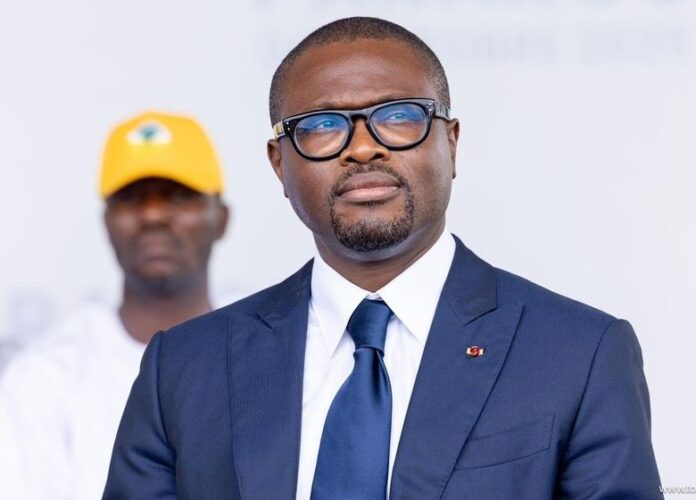
One week before the official campaign opens for the April 12 presidential vote, Benin enters the final stretch with an oddly narrowed field, a designated heir, and an opposition too constrained to impose its own rhythm. The scene looks orderly from afar. Up close, it looks more controlled than plural.
The Benin presidential election 2026 is no longer just a contest between candidates; it is becoming a test of political legitimacy in a system where the appearance of calm may hide a more stubborn imbalance. Romuald Wadagni, the current minister of economy and finance and the clear political successor to President Patrice Talon, has now presented his project at the very moment when the main opposition force, Les Démocrates, has confirmed it will back no one. That decision matters far more than the dry formula used to announce it. In politics, silence is rarely neutral. In Benin today, it sounds like an indictment.
Wadagni enters the race with the advantages one would expect from a man of the state, shaped by the machinery of power and presented, more or less openly, as the continuity candidate. He is facing Paul Hounkpè, the candidate of the FCBE, an opposition formation often described as moderate and, in the current context, tolerated within the narrowed perimeter of acceptable competition. That leaves one central fact hanging over the campaign: the country’s principal opposition party did not manage to field a candidate at all.
This is the detail that official language tends to flatten, as if it were merely procedural, almost administrative. It is not. When a major opposition party cannot place its own name on the ballot and then refuses to give voting instructions, the signal is unmistakable: the electoral field exists, yes, but it is no longer fully inhabited. Institutions may remain standing, yet the political substance inside them begins to thin out.
Benin presidential election 2026 enters a controlled final stretch
The Benin presidential election 2026 now takes shape in an atmosphere where the choreography is almost as important as the campaign itself. Wadagni is presenting a project, a platform, a future. Les Démocrates, by contrast, are presenting an absence. That contrast alone may define the final days before the vote.
There is, of course, a temptation among foreign observers to reduce such situations to formulas about democratic resilience, electoral maturity, or institutional continuity. Those phrases are neat, exportable, and usually detached from the harder political truth. A presidential race is not truly strengthened when its most significant opposition current is reduced to withholding endorsement because it could not place a candidate in the field. Order matters in politics, but order without genuine competition becomes brittle. It may preserve stability in the short term while quietly hollowing out confidence over time.
Wadagni’s move is therefore rational and well timed. He is filling the space that the system has left open. He is speaking as the man of continuity at a moment when continuity itself has become the dominant architecture of the contest. For voters who prize discipline, predictability, and state capacity, that message may resonate. Yet there is an obvious tension here: a victory achieved in a field so carefully narrowed may be legal, efficient, and institutionally tidy, while still failing to silence deeper doubts about representation.
What makes the Benin presidential election 2026 especially striking is not only who is running, but who is missing. Les Démocrates’ refusal to endorse either candidate can be read as tactical restraint, but it also reads as something harsher: a refusal to legitimize a game whose rules have already done much of the work. That is not abstention in the banal sense. It is a political gesture, cold and deliberate.
Wadagni’s project and the burden of succession
Romuald Wadagni’s challenge is now clear. It is not enough for him to look presidential; he must also look independent enough to escape the impression of pure succession. Being seen as Patrice Talon’s dauphin gives him structure, access, and momentum. It also gives him a burden. Every continuity candidate inherits not only the strengths of the incumbent order, but its fatigue, its exclusions, and its unresolved resentments.
That is where this campaign may become more fragile than it appears. A state-backed candidacy can project authority, competence, and seriousness. But voters are rarely blind to the difference between succession and renewal. The more heavily a campaign leans on continuity, the more it must prove that continuity still contains movement rather than simple reproduction.
And here, once again, the opposition vacuum changes the meaning of everything. Without a full-spectrum contest, every official message sounds louder, but not necessarily truer. Every campaign promise faces less contradiction, but also less democratic testing. In that sense, the race may become easier to win and harder to sanctify.
Mali’s prisoner release reveals the old grammar of weak states
Elsewhere in West Africa, the region’s harder realities continue to intrude. In Mali, several sources confirm that around one hundred presumed jihadists were released in the middle of the week in order to secure a truce in attacks targeting fuel convoys. The logic is familiar, even when governments prefer euphemism: when pressure becomes unmanageable, states bargain with the very forces they publicly claim to crush.
This is not a triumph of peace. It is a confession of strain. A government does not release such figures unless the logistical and security situation has become deeply serious. Fuel convoys are not symbolic targets; they are arteries. Once they are threatened persistently enough, the state begins to negotiate not from strength, but from necessity.
São Tomé’s cocoa growers show what rooted sovereignty looks like
In São Tomé, the picture is more constructive, though no less political in its own way. A new generation of cocoa producers is trying to cultivate the land while restoring damaged ecosystems, supported both by a local cooperative and by the FAO. It is the kind of story international agencies like to present as a development success, and sometimes, to be fair, such support does help sustain livelihoods.
Still, the real significance lies closer to the ground. Productive land, local organization, and the restoration of damaged environments are not abstract development slogans; they are the basis of durable sovereignty. Nations do not remain stable through declarations alone. They remain stable when people can work, produce, and pass something viable to the next generation.
A race that looks calm, but not entirely settled
Benin now approaches its presidential vote in a climate that is less explosive than many of its neighbors, but perhaps more politically revealing for that very reason. The country is not facing open rupture. It is facing something subtler: a managed contest whose formal order may conceal a deeper democratic narrowing.
Wadagni has stepped forward with a project. Les Démocrates have stepped back without blessing anyone. Between those two moves lies the real story of the election. Not chaos, not collapse, but a controlled imbalance that says much about the present condition of power in Benin. Elections are meant to organize legitimacy. Sometimes, however, they merely display the boundaries within which legitimacy is allowed to exist.

