


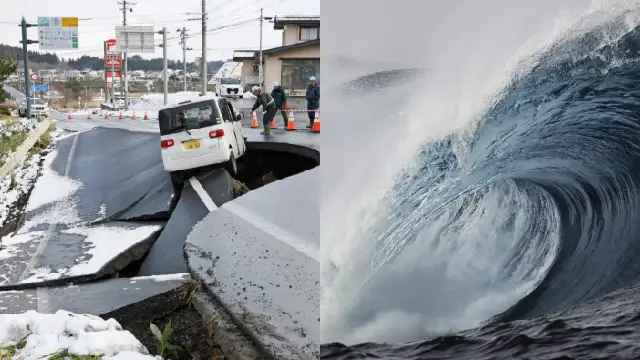
A tsunami alert Japan earthquake scenario unfolded once again on Monday, after a powerful offshore tremor struck the country’s northeast and sent waves toward the Pacific coast. The first reports pointed to a preliminary magnitude of 7.4, though several outlets later cited 7.5, a familiar reminder that in the first minutes after a major quake, even official numbers can shift while the danger does not. Japan’s Meteorological Agency warned of possible waves up to three meters, and smaller waves were already recorded at Kuji port in Iwate shortly after the shock.
Tsunami Alert Japan Earthquake: The North Coast Moves Again
The earthquake struck at 4:53 p.m. local time off the coast of Iwate, in the Pacific waters of northern Honshu. Its depth was reported at around 10 kilometers, shallow enough to raise immediate fears of tsunami activity and broad enough in impact for tremors to be felt as far away as Tokyo, where tall buildings reportedly swayed. Authorities issued evacuation warnings for coastal and riverside areas, while transport disruptions and emergency response measures were quickly put in place.
What stands out, as always in Japan, is not only the violence of the earth beneath the sea, but the speed of the state machinery above it. NHK cut programming. Local authorities moved to evacuate exposed areas. Fishing vessels headed out from port, a ritual of survival that says more than official communiqués ever do: on these coasts, experience has taught people that hesitation is often more dangerous than panic.
The first observed waves were not catastrophic in size, with reports of roughly 70 to 80 centimeters at Kuji and nearby points, but that is precisely how these episodes often deceive outside observers. A tsunami is not judged only by its first visible surge. It comes in repetitions, in intervals, in false lulls that tempt people back toward the shoreline. Japan’s weather agency explicitly warned residents not to leave safe ground until the alert was lifted.
The Shadow of 2011 Still Governs Every Warning
No country in the world reads a tsunami bulletin quite like Japan, because no country of this size has absorbed modern trauma in such concentrated form. The memory of March 2011 remains the country’s unspoken background noise: the magnitude 9.0 quake, the wall of water, the mass death, the nuclear disaster, and the lasting realization that advanced systems do not abolish vulnerability. That earlier catastrophe killed or left missing roughly 20,000 people, depending on the count cited, and permanently altered Japan’s national reflexes.
That is why every tsunami alert Japan earthquake episode now carries a dual meaning. It is both an immediate emergency and a test of national memory. The country knows the choreography: warnings, evacuations, suspended rail links, emergency task forces, repeated television messages, and the sober insistence that the second wave can be worse than the first. Prime Minister Sanae Takaichi’s government moved to set up a crisis response team, while utilities said no abnormalities had been reported at relevant nuclear facilities in the affected region.
A Tectonic Nation That Lives With Permanent Risk
Japan sits on the collision line of major tectonic plates along the Pacific Ring of Fire, which makes seismic instability less an exception than a permanent national condition. The northeastern coast, including Iwate, has long been exposed to this strategic geography of risk, where the ocean can turn from commercial corridor to killing force in minutes. The official language is technical, understandably so, but the political truth is more severe: a modern nation can prepare, drill, model, and reinforce, yet still remain hostage to geology.
And that is where media treatment often becomes too mechanical. International headlines quickly reduce events like this to a sequence of numbers, depths, and wave heights, as though the story were merely seismological. It is not. It is civilizational. Japan’s seriousness in the face of natural risk reflects something many Western governments have half-forgotten: order matters, discipline matters, and national resilience is not improvised on the day of disaster. It is built over decades, often in the shadow of grief.
A Warning, Not Yet a Catastrophe
For now, the event appears to be a serious but contained emergency rather than a repeat of 2011. Yet the caution remains justified. Aftershocks are possible, wave patterns can remain unstable, and coastal populations know that early reassurance is often the most misleading signal of all. The tsunami alert Japan earthquake story is therefore not only about what has already happened, but about what Japan has learned never to dismiss too quickly.
In the end, what Monday’s earthquake revealed was less a breakdown than a national reflex under pressure. The sea moved, the warnings sounded, and Japan responded with the cold discipline of a country that understands, perhaps better than any other, that nature does not negotiate and that survival begins with taking the threat seriously before the rest of the world has even finished reading the headline.

