


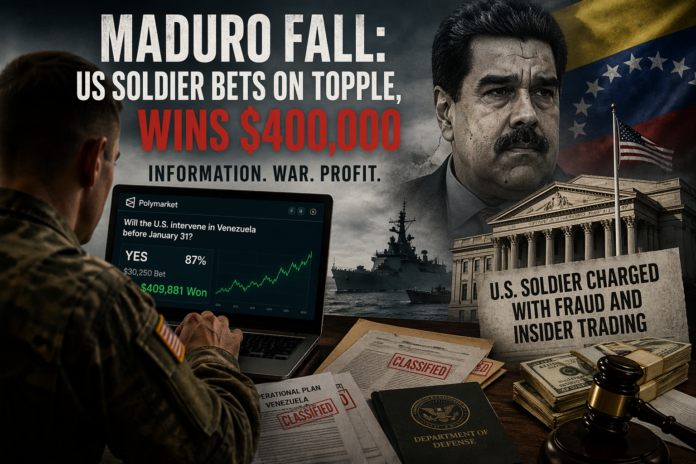
A revealing scandal behind the Maduro fall
The Maduro fall is not merely unfolding through official statements issued by Washington or through carefully staged images of a fallen leader transferred under heavy guard to a US courtroom. It is also surfacing, more discreetly, in the opaque margins of a system where a soldier—expected to embody discipline and secrecy—turned a geopolitical operation into a speculative opportunity.
US Army sergeant Gannon Ken Van Dyke, stationed at Fort Bragg, now stands indicted for monetizing what authorities cautiously describe as “classified information.” In reality, this meant privileged access to a forthcoming military operation targeting Nicolás Maduro—access he allegedly exploited by placing bets on prediction markets.
A well-oiled mechanism: information, anticipation, profit
Since December, Van Dyke reportedly placed over $30,000 across thirteen bets tied to a potential US intervention in Venezuela. Each position was aligned with a scenario that, at the time, remained officially within the realm of speculation.
Yet within closed military planning circles, speculation had already given way to certainty.
The outcome: more than $400,000 in profit. A striking return, driven not by intuition but by informational asymmetry—an advantage held by someone directly involved, according to prosecutors, in planning the operation that led to the Maduro fall.
The more unsettling question lingers beneath the surface: how many others, better positioned and more discreet, may have acted similarly without detection?
Washington between moral posture and structural ambiguity
The US Department of Justice, through acting official Todd Blanche, reiterated that access to classified intelligence entails absolute responsibility. A predictable statement—almost procedural.
Yet the discomfort is palpable.
At the same time, Donald Trump, when questioned about prediction markets, described a “world turned into a casino”—a remark that carries a certain irony given his own historical ties to that very industry.
The contradiction stands exposed: condemning excesses while operating within a system that not only enables them but, arguably, incentivizes them.
Polymarket and the commodification of intelligence
At the center of the case, the platform Polymarket claims it flagged suspicious activity and cooperated with authorities. A familiar defensive posture—one that does little to dispel the broader impression of a system where strategic information becomes a tradable asset.
These so-called “prediction markets” are no longer mere analytical tools reflecting collective expectations. They are increasingly becoming arenas where those with privileged access can convert foresight into profit.
And the Van Dyke case is unlikely to be isolated.
Weeks earlier, significant bets placed ahead of a US strike on Iran reportedly generated over $1 million in gains. No arrests followed. No accountability clearly established.
The silence, in itself, is telling.
A creeping kleptocracy?
Criticism is mounting, notably from Bernie Sanders, who denounced what he called an “unprecedented kleptocracy.” A harsh assessment—yet one that resonates in light of recent financial signals.
Suspicious oil trades executed minutes before sensitive political announcements, massive profits tied to deregulated cryptocurrency markets, and overlapping interests between political power and private capital all point toward a troubling convergence.
The Van Dyke affair, far from being an isolated breach, may instead be a symptom—a visible fracture in a system where the boundary between state power and personal gain is becoming increasingly blurred.
The strategic drift of a system losing control
What this episode ultimately reveals is not just the fall of a foreign leader, but the internal erosion of a model that claims to uphold transparency and rule of law.
The Maduro fall, in this light, appears less as a decisive geopolitical victory than as a moment exposing deeper dysfunctions within the American apparatus itself—where information leaks, financial opportunism, and political ambiguity intersect.
And in that convergence lies perhaps the most consequential risk: not external instability, but the gradual normalization of insider advantage at the very heart of power.

