


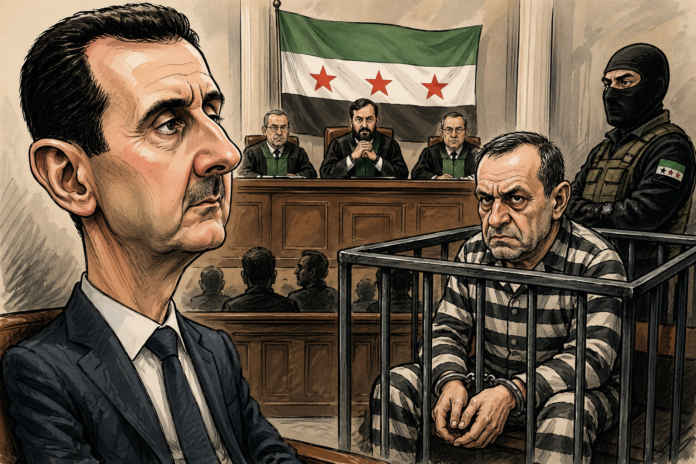
The Bachar al-Assad trial has opened in Syria, and with it a strange, heavy page of Middle Eastern history is being turned under the eyes of a country still surrounded by ruins, foreign calculations, and official declarations that should be read with caution.
A Trial That Begins With an Absence
The first hearing against Syria’s deposed president Bachar al-Assad and key members of his clan took place on Sunday, April 26, in a Syrian court. Assad himself was not there. Nor was his brother Maher. Both fled Syria after their fall in December 2024 and will be tried in absentia.
The only visible figure of the old regime in the courtroom was Atef Najib, Assad’s cousin and former head of political security in Deraa, the southern city where the 2011 uprising first caught fire. He appeared handcuffed, dressed in a striped prison uniform, accused of leading a broad campaign of repression and arrests during the first days of the revolt.
This is the first image the new Syria wants the world to see: not Assad in Moscow, not Maher in exile, but a regime man reduced to silence before a court.
Bachar al-Assad Trial and the Politics of Transitional Justice
Judge Fakhr al-Din al-Aryan opened the hearing by declaring that Syria was beginning its first trials under transitional justice. The phrase is familiar, almost diplomatic in its neatness. Yet in Syria, nothing about justice can be neat.
The judge said the case concerned one detained accused present in court, as well as others who had evaded justice. Atef Najib was not questioned during this first session, which was limited to administrative and legal preparations. A second hearing was scheduled for May 10.
President Ahmed al-Charaa stated on X that justice would remain a major objective for the state and its institutions. It was a necessary sentence, but also a political one. Every new regime speaks the language of justice; the real test is whether it can resist turning justice into theatre.
The Clan That Ruled for Five Decades
The fall of Bachar al-Assad and his flight to Moscow ended more than five decades of absolute rule by the Assad clan. It was a system built not only on ideology, but on family, intelligence networks, military loyalty, fear, and the cold logic of survival.
Atef Najib’s role matters because Deraa was not just another city. It was the spark. The repression there helped transform protests into revolt, revolt into war, and war into the long dismemberment of Syria.
According to judicial sources, other key figures from the former regime are expected to face trial, including Wassim al-Assad, another cousin of the former president; Amjad Youssef, suspected of involvement in a 2013 massacre; and pilots accused of bombing Syrian cities.
The Bachar al-Assad trial therefore begins not with one man, but with a structure: the security state, the military machine, the family network, and the prison system.
A Country Still Counting Its Dead
The Syrian war lasted 13 years and killed more than half a million people. Government forces bombarded rebel-held areas. Tens of thousands disappeared, many inside prisons that became, for Syrians, the darkest symbol of the regime.
The new Islamist authorities have arrested several former officials and promised accountability for the crimes of the previous power. Yet this promise opens another question, one Western chancelleries prefer to treat with polite silence: who will judge the judges?
Syria does need justice. But it also needs order, sovereignty, and a state strong enough not to become a playground for foreign interests, militias, intelligence services, and humanitarian rhetoric masking strategic appetites.
Justice, or a New Political Stage?
The opening of the Bachar al-Assad trial is undeniably historic. But history in the Middle East is rarely clean. A courtroom can reveal truth, but it can also serve power. It can punish crimes, but it can also erase inconvenient alliances, external responsibilities, and the role of those who helped turn Syria into a battlefield.
For now, Assad is absent, Maher is absent, and Moscow’s shadow hangs silently over the file. In Damascus, Atef Najib sits in a cage of procedure and symbolism. The old regime is being judged, but the new Syria is also placing itself on trial.
The verdict that matters will not only concern Bachar al-Assad. It will concern whether Syria can rebuild a state from the ruins of vengeance, occupation, sectarian fracture, and imported diplomacy. That is where justice begins — and where official speeches usually end.

