


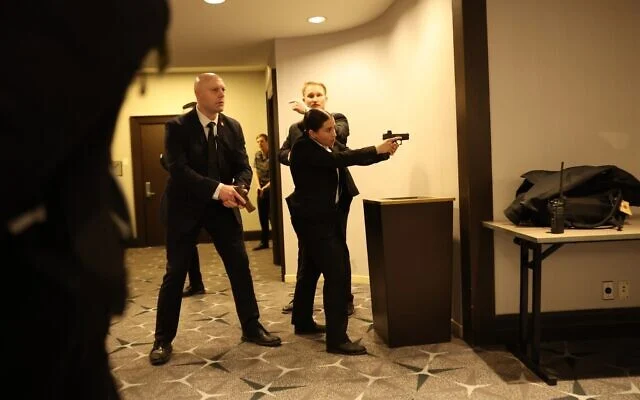
In an already fractured America, the Trump assassination attempt press gala during what should have been a ritual celebration of journalism reveals far more than an isolated act. Between tightly controlled official messaging, troubling security gaps, and immediate political exploitation, the Cole Allen case fits into a broader pattern where violence is no longer an anomaly—but a signal.
An attack at the heart of media power
The setting was anything but trivial: the prestigious White House Correspondents’ Dinner, a carefully staged convergence of political authority and media influence.
It is precisely there that the rupture occurred.
Cole Thomas Allen, 31, attempted to breach a security checkpoint armed with a shotgun, a semi-automatic handgun, and knives. Before he could approach Donald Trump, shots were fired. The United States Secret Service intervened swiftly, evacuating the president, Melania Trump, and Vice President J. D. Vance.
Officially, the system worked. Unofficially, a more uncomfortable question lingers: how did such a heavily armed individual get that close in the first place?
Security failure or controlled narrative?
Trump assassination attempt press gala: a system under scrutiny
Institutional communication emphasizes efficiency. Yet several elements disrupt that narrative. The suspect reportedly passed an initial layer of security before triggering a response—an anomaly in environments designed for layered, redundant protection.
In high-level security doctrine, failure is rarely singular; it is systemic.
Even more revealing was the rapid release of surveillance footage via Truth Social, the president’s own platform. This direct communication bypasses traditional verification channels, imposing a raw, emotional framing—one that shapes perception before facts settle.
An America gripped by ideological tension
The White House quickly pointed to a familiar culprit: “hatred from the left.” A clear political line, consistent with a broader strategy of narrative polarization.
Yet reality is rarely so linear. The suspect allegedly authored an “anti-Christian” manifesto—an element rapidly integrated into conservative discourse as evidence of civilizational decay. Still, such acts often emerge from a volatile mix of ideological fixation and personal instability.
The Trump assassination attempt press gala thus becomes a political canvas, onto which competing narratives are projected.
A troubling pattern
This is not an isolated episode. Since 2024, Donald Trump has faced multiple threats—from campaign rallies to private venues.
History echoes uncomfortably: Ronald Reagan was shot in 1981 just outside the same Hilton hotel.
As these incidents accumulate, one trend becomes difficult to ignore: the normalization of political violence.
More symptom than anomaly
What unfolded in Washington goes beyond a security breach. The Trump assassination attempt press gala serves as a stark indicator of systemic strain—where protection falters, communication overtakes clarity, and violence increasingly embeds itself in political life.
In such a climate, the real question is no longer whether such events will recur—but how they will be interpreted, leveraged, and remembered.

