


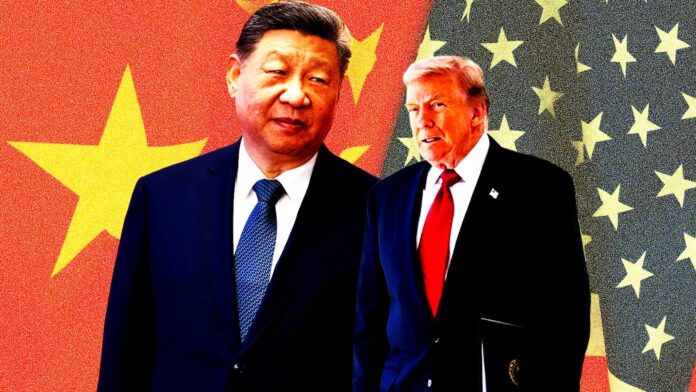
A Summit That Reveals a Global Turning Point
Trump and Xi Jinping in Beijing: behind the carefully staged handshakes and the diplomatic statements polished to perfection, this Sino-American summit looks less like a routine bilateral meeting and more like a moment of strategic clarification. Nine years after the lavish imperial reception Donald Trump received inside the Forbidden City, the atmosphere has changed completely. Beijing no longer feels the need to impress Washington with the grandeur of its past. China now believes it can impose the reality of its present power.
The American president arrives in Beijing weakened by several simultaneous crises: instability in the Middle East, an unfinished trade war, persistent inflation in the United States, and growing doubts about Washington’s ability to preserve its global leadership. Facing him, Xi Jinping moves with the calm discipline of a leader convinced that history is now moving in his favor.
Trump and Xi Jinping in Beijing: A Summit Under Global Pressure
Back in 2017, Xi Jinping welcomed Donald Trump almost like an emperor receiving a prestigious guest. A private tour of the Forbidden City, an exceptional state dinner, meticulous symbolism: Beijing was still trying to seduce and reassure.
This time, the tone is radically different. The summit scheduled for May 13–14, 2026, takes place in the middle of an open economic and strategic confrontation. The list of explosive topics keeps growing: Taiwan, artificial intelligence, trade sanctions, Iranian oil, technological supremacy, maritime security, and control over critical resources.
Across diplomatic circles in Europe and Asia, many now see this meeting as a potential geopolitical turning point. Not because a spectacular agreement is expected, but because it may confirm a deeper evolution: the slow erosion of American authority in front of a China that no longer hides its ambitions.
The Trump administration attempted, immediately after returning to the White House, to relaunch a massive trade offensive against Beijing with tariffs reaching 145 percent. Yet the episode quickly exposed the limits of Washington’s strategy. China responded with precision by restricting exports of rare earth minerals, those essential materials required for modern technological and military industries.
The message sent by Beijing was unmistakable: China fully understands America’s structural vulnerabilities and now intends to exploit them without hesitation.
Rare Earths: Beijing’s Silent Weapon
For years, many Western governments treated rare earth minerals as a secondary industrial issue. The reality is far more strategic.
China controls a dominant share of the global refining chain for these critical materials used in smartphones, semiconductors, electric batteries, and, above all, modern weapons systems. Meanwhile, the recent Middle Eastern conflicts have severely depleted American military stockpiles.
This dependency has now become a major geopolitical lever.
Washington is attempting to diversify supplies through agreements with African countries, Australia, and parts of Latin America. But such projects require years of infrastructure and investment. Beijing already possesses the entire supply chain.
In this context, China increasingly appears not merely as a commercial competitor, but as a power capable of technologically suffocating its adversaries if tensions ever cross a critical threshold.
Perhaps the most striking element is the contrast between official American rhetoric and industrial reality. While Washington insists on containing Chinese power, a significant portion of its own military-industrial apparatus still indirectly depends on resources controlled by Beijing.
The Iran Conflict Further Weakens Washington
The Middle Eastern situation only complicates the American position further.
The tensions surrounding Iran, the instability in the Strait of Hormuz, and the persistent volatility of global energy markets have damaged the international image of the United States. Several European allies increasingly criticize Washington’s diplomacy as unpredictable, aggressive, and often contradictory.
In Beijing, this situation is observed with a mixture of caution and opportunism.
China now presents itself as a relatively stable power focused on economic continuity, trade security, and strategic predictability. This narrative resonates particularly well across Asia, where several governments increasingly view Beijing as a more pragmatic and less ideological partner than Washington.
The irony is difficult to ignore. For decades, the United States claimed the role of guarantor of the global order. Today, China is attempting to inherit that role while the American administration multiplies confrontations without always possessing the industrial or political capacity to sustain them.
Even peripheral signals reinforce this perception: temporary airspace closures across strategic regions, nervous energy markets in Asia, discreet increases in Chinese investments in key port infrastructure. These are the kinds of weak signals suggesting that Beijing is carefully preparing for the long term while Washington remains trapped managing emergencies.
American CEOs as Trump’s Economic Lifeline
Donald Trump nevertheless arrives in Beijing with important assets.
The American delegation includes several major figures of technological and financial capitalism: Elon Musk, Tim Cook, executives from Boeing, Meta, and Goldman Sachs. Their presence highlights a reality often hidden beneath political rhetoric: despite official tensions, the American and Chinese economies remain deeply interconnected.
For Trump, the objective is twofold.
First, secure commercial agreements capable of reassuring financial markets ahead of the upcoming midterm elections. Second, remind Beijing that China still depends heavily on the American market, the strength of the dollar, and access to Western consumption.
Yet this strategy also reveals an implicit weakness.
When corporate executives become the true intermediaries between two superpowers, it often reflects the inability of states themselves to impose political outcomes alone. Beijing understands this perfectly and exploits this mutual dependency with remarkable discipline.
Taiwan: The Red Line That Could Change Everything
The Taiwan issue will likely become the true political test of this summit.
Beijing has long demanded a reduction in American weapons deliveries to Taipei. Until now, Washington maintained a carefully calibrated strategic ambiguity, repeating that the United States “does not support Taiwan independence.”
However, several diplomats now fear a far more consequential semantic shift. If the Trump administration were to evolve toward a stronger formulation expressing “opposition to Taiwan independence,” it would represent a major strategic victory for Xi Jinping.
Because behind the wording lies the essential issue: the gradual recognition of a new balance of power in the Asia-Pacific region.
For Beijing, Taiwan is not simply a territorial question. It symbolizes the decline of American dominance in a region that Washington controlled militarily since the end of the Second World War.
And for the United States, conceding ground on this issue would amount to implicitly recognizing that the global strategic balance is beginning to tilt.
Xi Jinping Advances with Time on His Side
Ultimately, this summit may reveal a far more uncomfortable reality for Western capitals: China no longer needs to rush.
Xi Jinping can afford patience. His domestic power appears consolidated, China’s economy may be slowing but remains enormous, and Beijing continues methodically expanding its diplomatic, industrial, and military influence.
Donald Trump, meanwhile, operates under constant political pressure. Between electoral deadlines, domestic tensions, and international crises, the White House must constantly deliver rapid and visible results.
This difference in political temporality may well constitute China’s greatest advantage.
In Beijing, Xi Jinping negotiates like a leader convinced that history is moving in his direction. In Washington, Donald Trump negotiates like a president still trying to convince his own public that America remains the world’s dominant power.
And perhaps that is where the real balance of power at this summit truly lies.
The summit between Donald Trump and Xi Jinping in Beijing goes far beyond a routine diplomatic encounter. It highlights a genuine change of era.
China is no longer merely challenging American influence; it is openly testing Washington’s real capacity to defend the global order it once built.
The United States still retains formidable advantages — military power, financial dominance, technological innovation — but increasingly projects the image of a superpower stretched across too many fronts at once.
Xi Jinping advances cautiously, but with visible confidence. Donald Trump, meanwhile, must still prove that he can impose his terms.
In Beijing this week, the question will not simply concern trade or diplomacy. It will concern which power — Washington or Beijing — will define the rules of the next decade.

