


Moscow stages Russia nuclear exercises while Putin deepens ties with China
As the diplomatic theater surrounding Ukraine continues to harden into something darker and more unpredictable, the announcement of new Russia nuclear exercises from May 19 to May 21 is not merely another military communiqué emerging from Moscow. It is a message — cold, deliberate, and aimed far beyond Kiev. At the precise moment Vladimir Putin lands in China seeking to consolidate the Eurasian axis with Xi Jinping, the Kremlin activates thousands of troops in drills centered around the operational readiness of nuclear forces.
Officially, the Russian Ministry of Defense framed the exercises as preparation “in the event of a threat of aggression.” But in the language of strategic powers, particularly nuclear ones, such wording is never accidental. It is crafted for Western capitals, for NATO headquarters, for financial markets quietly monitoring instability, and perhaps most importantly, for Washington itself — whose rhetoric has increasingly oscillated between escalation and strategic confusion.
The Russian military confirmed that the three-day operation would involve training connected to the deployment and potential use of nuclear weapons systems. The announcement follows one of the largest drone offensives carried out by Ukraine on Russian territory since the beginning of the war, an attack Moscow immediately integrated into its broader narrative of existential confrontation.
A strategic signal disguised as military routine
The Western media reflexively labels these announcements as “shows of force,” yet that interpretation only captures part of the reality. The deeper issue is timing. Putin’s visit to China coincides with an accelerating geopolitical fracture between the Atlantic bloc and the emerging Eurasian partnership. In that environment, the Russia nuclear exercises appear less like isolated drills and more like calibrated geopolitical signaling.
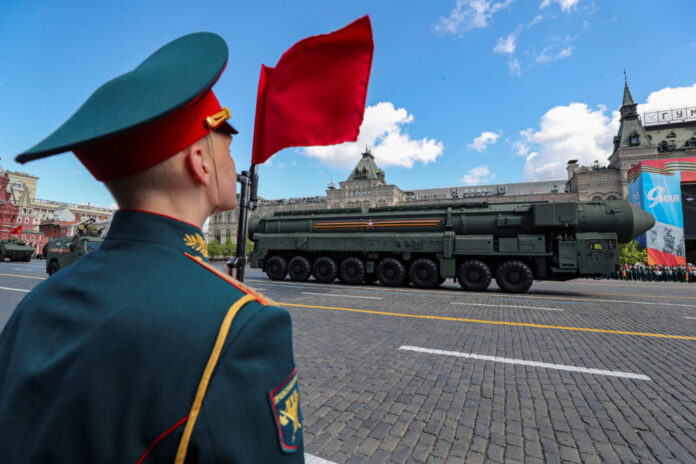
One should also observe what is not openly stated. Russia does not conduct nuclear readiness exercises in complete isolation from diplomatic objectives. The Kremlin understands perfectly well that images of Yars intercontinental ballistic missiles, strategic command centers, and mobilized units create psychological pressure disproportionate to any actual battlefield movement.
This is where Western narratives often become contradictory. European leaders continue to insist publicly that Russia is weakened, isolated, and economically exhausted, yet every major NATO briefing simultaneously warns of a prolonged confrontation requiring massive rearmament. Both narratives cannot fully coexist indefinitely.
Meanwhile, Beijing watches carefully. China officially promotes stability and restraint, but it also benefits strategically from a distracted United States consumed by multiple theaters simultaneously — Ukraine, the Middle East, and tensions in the Pacific. Putin’s arrival in China during these Russia nuclear exercises therefore carries symbolic weight far beyond ceremonial diplomacy.
The shadow of escalation remains deliberately ambiguous
The Kremlin has mastered the art of maintaining strategic ambiguity. Moscow rarely issues direct threats in explicit language anymore. Instead, it relies on layered signals: closed airspace zones, military drills, unusual troop movements, sudden missile tests, and carefully choreographed statements from defense officials.
This pattern matters because modern deterrence no longer functions solely through military capability. It functions through uncertainty. The objective is to force adversaries into caution without crossing the threshold into open conflict.
The Russian Ministry of Defense announced that the exercises would focus on the “preparation and use” of nuclear weapons under conditions of aggression. Such phrasing is intentionally elastic. In practice, it allows the Kremlin to continuously redefine what it considers a direct threat.
At the same time, Ukraine’s massive drone strikes inside Russian territory have altered part of the strategic equation. Moscow now portrays these attacks not as isolated tactical incidents, but as evidence of growing Western involvement. Whether this interpretation reflects reality entirely is secondary; what matters is that the Kremlin uses it to justify military escalation narratives internally and externally.
Europe enters a dangerous strategic phase
For Europe, the situation is increasingly uncomfortable. European governments continue to align closely with Washington’s security architecture while simultaneously facing economic stagnation, energy vulnerabilities, and growing domestic fatigue over prolonged confrontation.
There is also a broader civilizational dimension often ignored in mainstream commentary. Russia presents itself not simply as a military power defending territory, but as a state resisting what it describes as Western ideological expansionism. This narrative resonates far beyond Russia itself, particularly in parts of Asia, Africa, and the Global South where distrust of Anglo-American foreign policy remains deeply rooted.
The danger, however, lies in normalization. Repeated nuclear exercises gradually shift public perception. What once appeared extraordinary begins to feel routine. Yet nuclear signaling between major powers is never routine, regardless of how frequently it occurs.
Behind the official statements, behind the carefully managed press releases, and behind the diplomatic choreography surrounding Putin’s China visit, one uncomfortable reality persists: the architecture of global deterrence is becoming more unstable, more multipolar, and considerably less predictable than at any point since the end of the Cold War.
Conclusion
The latest Russia nuclear exercises are not merely technical drills conducted by the Russian armed forces. They are part of a broader strategic narrative aimed at reminding adversaries that Moscow still possesses escalation dominance in certain domains despite the grinding attritional war in Ukraine.
Whether these exercises represent deterrence, intimidation, or preparation for a harsher phase of geopolitical confrontation depends largely on how Western capitals respond in the coming months. But one thing is increasingly clear: the era of post-Cold War strategic complacency is over, and the global balance of power is entering a far more volatile chapter.

