


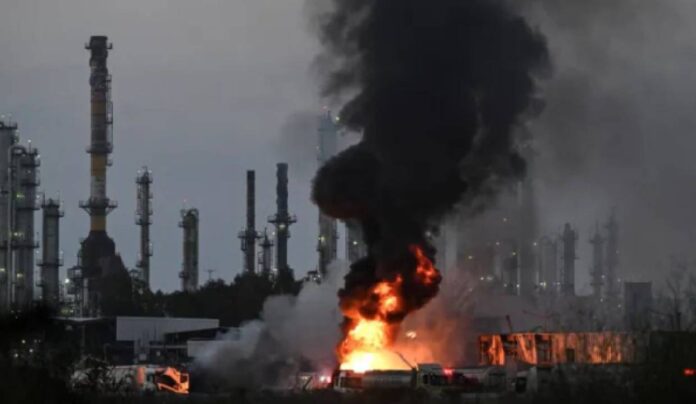
An Attack on Barakah That Goes Beyond a Simple Military Incident
The Barakah drone strike likely marks a far more serious turning point than a routine regional provocation. Behind Abu Dhabi’s cautious statements, behind the carefully calibrated language coming from Western chancelleries, one reality emerges with disturbing clarity: the Gulf has entered a phase in which civilian nuclear infrastructure is becoming a symbolic, indirect, and potentially experimental target.
And in a region saturated with American weapons systems, Western military bases, and air-defense networks marketed as nearly untouchable, the incident at Barakah now stands as a brutal demonstration of vulnerability.
On Sunday evening, a drone struck the vicinity of the Barakah nuclear power plant in the United Arab Emirates, sparking a fire near an electrical generator without causing casualties or radioactive leaks. Yet the political significance of the event extends far beyond the limited physical damage. Emirati authorities denounced an “unacceptable aggression” and a “dangerous escalation,” while several Gulf officials indirectly hinted that Iran, or networks linked to Tehran, could be involved.
In the Middle East, words are rarely chosen by accident. When Emirati officials describe a drone strike near a nuclear facility as “terrorism,” they are not merely informing the public — they are laying the diplomatic groundwork for a possible escalation.
Barakah Drone Strike Reveals the Gulf’s Security Weaknesses
What is most troubling about this Barakah drone strike is not simply that one drone reached its target. It is that two additional drones were intercepted beforehand. That detail matters enormously.
It means Emirati air defenses — built over years through massive American military contracts worth billions of dollars — detected a coordinated penetration only after the operation was already underway.
For months, Gulf monarchies have publicly projected confidence in the American strategic umbrella. Yet weak signals continue to accumulate: asymmetric attacks multiplying across the region, persistent vulnerability of energy infrastructure, gradual saturation of missile defense systems, and even discreet adjustments to civilian air traffic routes above the peninsula.
Financial markets, too, immediately understood the deeper implications. Investors know that a successful strike near a nuclear installation in the Gulf can trigger geopolitical shockwaves far beyond the scale of the immediate damage. Critical infrastructure throughout the region is increasingly exposed to low-cost attacks carrying enormous psychological and strategic impact.
That is precisely the logic behind modern drone warfare: forcing wealthy and technologically superior states into a permanent condition of insecurity.
Iran at the Center of Suspicion Without Formal Accusation
Abu Dhabi still avoids directly accusing Tehran. Yet the implications are unmistakable.
Presidential adviser Anwar Gargash referred to the strike as a “terrorist attack,” possibly carried out either by the “main perpetrator” or by “its agents.” It is classic Gulf diplomatic language: ambiguous enough to preserve a communication channel, but sufficiently explicit to guide international opinion toward a clear suspect.
Since the April 8 ceasefire that temporarily froze hostilities involving Iran, Israel, and the United States, the UAE has repeatedly accused the Islamic Republic of sustaining controlled regional instability.
But the situation appears more complex than official narratives suggest.
Tehran’s strategy increasingly resembles calibrated pressure rather than direct confrontation. Anonymous drones, indirect operations, paramilitary intermediaries, and contradictory diplomatic messaging allow Iran to maintain strategic ambiguity while constantly testing the resolve of its rivals.
Iranian officials continue their own psychological campaign. Mohammad Bagher Ghalibaf declared that the American military presence in the region generates more insecurity than stability — a statement that resonates far more strongly after the Barakah incident.
Washington Issues Threats While Strategic Doubts Grow
As often happens in moments of Middle Eastern crisis, the American response oscillates between verbal intimidation and operational ambiguity.
Donald Trump once again threatened Iran with “annihilation,” warning that “nothing will remain” if Tehran fails to reach an agreement with Washington quickly.
Yet behind these dramatic declarations lies a more uncomfortable question: does Washington still possess a coherent long-term strategy for the Middle East?
For years, the United States has projected an image of strategic inconsistency — partial withdrawals followed by selective military re-engagement, aggressive rhetoric coupled with diplomatic hesitation. This ambiguity itself feeds instability.
Regional allies continue purchasing American defense systems while simultaneously observing that no security architecture appears capable of fully stopping low-cost asymmetric threats.
The Barakah drone strike therefore functions as more than a regional incident. It exposes the limits of deterrence in a Gulf supposedly protected by one of the largest concentrations of Western military power in the world.
A Region Trapped in Controlled Escalation
The International Atomic Energy Agency expressed its “deep concern,” the sort of diplomatic language that often signals far greater anxiety behind closed doors.
Because even without radioactive contamination, the mere fact that a civilian nuclear facility has entered the logic of regional confrontation represents a dangerous strategic rupture.
At the same time, Israeli strikes continue in Lebanon despite the extension of a nominal ceasefire. Hezbollah maintains rocket attacks. Iran threatens Gulf oil infrastructure if directly targeted. Pakistan attempts discreet mediation efforts that few actors seem genuinely interested in supporting.
The broader Middle East increasingly resembles a strategic theater where every actor claims to seek stability while simultaneously multiplying the actions that make a wider conflict more likely.
The Barakah drone strike should not be viewed as an isolated event. It reflects a deeper transformation in Middle Eastern power dynamics: critical infrastructure is becoming a geopolitical pressure tool, Western alliances appear less deterrent than they once were, and regional powers are now engaged in a prolonged war of psychological attrition.
In that environment, official reassurances sound increasingly disconnected from the strategic realities visible on the ground.
Behind the diplomatic communiqués and carefully staged statements, one conclusion slowly becomes unavoidable: the Gulf has entered a prolonged zone of instability where even a single drone strike can now trigger disproportionate geopolitical consequences.

