


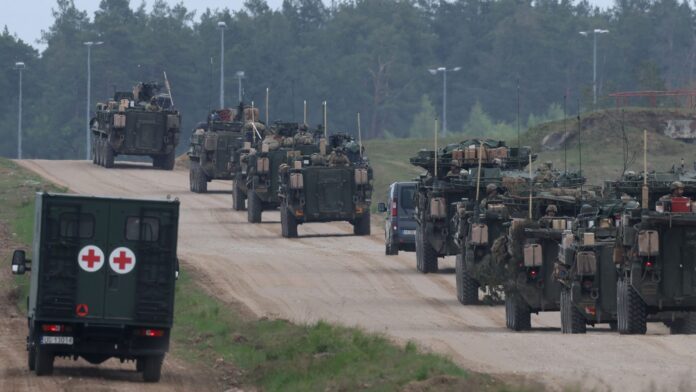
US troops in Poland are once again at the centre of Europe’s nervous strategic theatre. Donald Trump announced on Thursday that he would send 5,000 additional American soldiers to Poland, presenting the decision as a gesture of confidence toward Polish President Karol Nawrocki — but, as often with Trump’s diplomacy, the announcement says as much through its contradictions as through its stated intent.
US troops in Poland: reassurance or pressure tactic?
The American president made the announcement on Truth Social, linking it directly to Nawrocki’s election and to what he described as his strong relationship with the Polish leader. In Warsaw, the message will be read as reassurance. In Berlin, Brussels and Paris, it will sound rather different: another reminder that American protection is no longer automatic, but conditional, political and transactional.
That is the central point. The deployment of US troops in Poland is not merely a military decision. It is a signal. It rewards a conservative, Atlanticist Poland that still treats national defence as a serious matter, while humiliating those Western European capitals that prefer communiqués, summits and moral lectures to ammunition stocks, borders and deterrence.
The confusion, however, is impossible to ignore. Only days before Trump’s announcement, senior American officials had questioned or delayed a planned deployment of around 4,000 soldiers to Poland. The Pentagon had also been preparing reductions elsewhere in Europe, including Germany. Then came Trump’s sudden pledge of 5,000 additional troops, leaving allies to wonder whether Washington is reinforcing NATO’s eastern flank, reshuffling forces, or simply improvising in public.
Poland rewarded, Germany warned
Poland has understood something that much of Western Europe tried to forget: geography is destiny. A nation facing Russia across the flatlands of the East cannot afford the soft illusions of post-national Europe. It buys weapons, strengthens its army, cultivates Washington and speaks the language of sovereignty without embarrassment.
Germany, by contrast, remains the obvious loser in this American choreography. Trump’s administration had already announced a reduction of roughly 5,000 US troops from Germany, after months of irritation over Berlin’s strategic hesitations and its criticism of Washington’s war against Iran.
The message is brutal but coherent: those who pay, arm and align may receive protection; those who posture may receive lectures — or withdrawals.
NATO’s eastern flank becomes Washington’s bargaining table
Vice President JD Vance had insisted earlier this week that the Poland deployment was “delayed” rather than cancelled, while urging Europe to stand more firmly on its own feet. That sentence deserves attention. It is not isolationism in the old sense. It is burden-shifting under pressure.
Trump is not abandoning Europe outright. He is making Europe pay emotionally, politically and eventually financially for the American shield it has too long treated as a natural resource.
The war in Iran adds another layer. Trump has openly criticised NATO allies that failed to support the US-Israeli campaign more robustly, while Secretary of State Marco Rubio has pressed the alliance over its hesitation. The result is a strange strategic mixture: more troops for Poland, fewer certainties for Europe, and a NATO alliance increasingly governed by presidential mood, bilateral loyalty and public punishment.
The real question: how many troops, and for how long?
The phrase “additional 5,000” is doing a great deal of work. Are these soldiers permanent? Rotational? Replacing cancelled units? Connected to the German drawdown? No one appears fully certain, and that uncertainty is itself part of the story.
At present, around 10,000 American troops are already stationed in Poland, making it one of the key pillars of NATO’s eastern defence posture. If Trump’s pledge is implemented as stated, Poland’s role as the alliance’s forward bastion will be strengthened. If it is revised, delayed or reinterpreted, then the announcement will join the growing pile of American strategic signals that allies are forced to decode like palace rumours.
Poland rises as Europe hesitates
The deployment of US troops in Poland is not just a military reinforcement. It is a political verdict.
Poland is being rewarded because it takes sovereignty seriously. Germany is being warned because it mistook economic weight for strategic credibility. Brussels is being exposed because it still dreams of autonomy without the hard instruments of power.
Trump’s announcement may be disorderly, impulsive and wrapped in personal politics. But beneath the noise lies a colder truth: Europe’s security order is being rewritten, not in seminar rooms or EU declarations, but through troop movements, cancelled deployments and presidential threats. Poland has chosen to stand where history is dangerous. Much of Western Europe is still negotiating with reality.

