


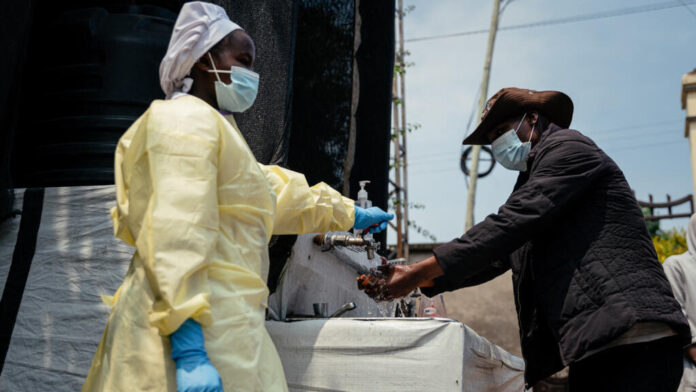
The Ebola outbreak DR Congo is no longer merely a regional health emergency. It is rapidly becoming a geopolitical stress test exposing the contradictions, hesitations, and strategic ambiguities of Western governments. While the World Health Organization warns about the “scale and speed” of the epidemic, Washington simultaneously strengthens border health controls and authorizes the Congolese national football team to participate in the 2026 World Cup. The message is confused, almost schizophrenic, and it reveals once again how political optics frequently override coherent crisis management.
Behind the carefully crafted statements coming out of Geneva, Brussels, and Washington, the atmosphere feels noticeably more tense than officials are willing to admit publicly. In crises like these, governments rarely reveal the full extent of their concerns in the early stages. Instead, the real signals emerge elsewhere: emergency coordination meetings, discreet medical transfers, sudden surveillance measures, and increasingly nervous diplomatic language.
The Ebola Outbreak DR Congo Is Escalating Rapidly
The World Health Organization convened an emergency expert meeting as the Ebola outbreak continues spreading across eastern Democratic Republic of Congo. According to official figures, the epidemic has already caused 131 suspected deaths and more than 500 suspected cases.
What makes this situation especially alarming is the strain involved. The Bundibugyo variant currently circulating has no approved vaccine and no validated treatment protocol. That single fact changes everything. Unlike previous Ebola waves where experimental containment tools existed, international authorities now face a virus against which available defenses remain uncertain.
Tedros Adhanom Ghebreyesus declared himself “deeply concerned” about the outbreak’s rapid progression. In the coded language of international institutions, such wording usually indicates fears far beyond what public statements openly acknowledge.
The sequence of reactions is revealing. The International Federation of Red Cross and Red Crescent Societies activated its highest response level. Africa CDC declared a continental public health emergency. France introduced precautionary measures for Mayotte. The United States reinforced health screenings at borders. When so many systems move simultaneously, it generally means intelligence assessments behind closed doors are considerably darker than public briefings suggest.
Washington Criticizes WHO While Protecting Its Own Interests
The American position appears particularly contradictory. On one hand, Marco Rubio openly accused the WHO of reacting too slowly to the Ebola outbreak. The criticism fits neatly within the broader nationalist skepticism toward global institutions promoted by Donald Trump and his political circle.
Yet almost simultaneously, Washington confirmed that the Congolese national football team would still be permitted to enter the United States for the 2026 FIFA World Cup.
The contradiction is impossible to ignore. If the situation is serious enough to justify emergency border measures, why maintain complete openness for a high-profile international sporting event? The answer likely lies less in public health than in economics, diplomacy, and media management.
The Ebola outbreak DR Congo therefore becomes an exercise in strategic balancing. American authorities seek to appear vigilant without triggering panic, avoiding any move that could threaten the commercial and symbolic machinery surrounding the World Cup.
Central Africa Faces a Quietly Dangerous Situation
The emergence of cases in Uganda confirms what many observers feared from the beginning: the virus is no longer strictly confined geographically. In a region marked by porous borders, fragile healthcare systems, and heavy population movements, containment becomes extraordinarily difficult once cross-border transmission begins.
Félix Tshisekedi called for calm, insisting that authorities are strengthening the national response. Such messaging is predictable during the opening phase of a major epidemic. Governments often prioritize social stability and economic continuity before fully disclosing the scale of potential risks.
But markets, airlines, and regional logistics operators are already watching nervously. Air corridors, migration flows, and trade routes across Central Africa may become increasingly sensitive if the outbreak continues expanding.
Western Governments Still Struggle With Coherent Crisis Responses
Since Covid-19, Western leaders repeatedly claimed they had learned the lessons of global pandemic management. Yet the reactions surrounding this Ebola outbreak suggest otherwise. Instead of a coordinated doctrine, what emerges is fragmentation, improvisation, and political caution disguised as strategic planning.
France publicly describes the importation risk as “very low” while activating precautionary measures in Mayotte. Germany quietly prepares to treat an infected American citizen evacuated from Congo. The United States attacks WHO delays while simultaneously preserving its international sporting agenda.
The Ebola outbreak DR Congo once again exposes a recurring Western weakness: governments communicate confidence publicly while acting with visible anxiety behind the scenes.
A Health Crisis That Could Become a Geopolitical Crisis
Major epidemics rarely remain purely medical events for long. They rapidly evolve into diplomatic, economic, and security crises once international movement, trade, and public confidence begin to deteriorate.
The WHO’s increasingly alarmed tone, Africa CDC’s emergency declaration, growing Western border controls, and discreet international medical transfers all point toward a broader strategic concern developing beneath official narratives.
And while global institutions continue calibrating their language carefully, the virus itself continues moving far faster than diplomatic caution.

