


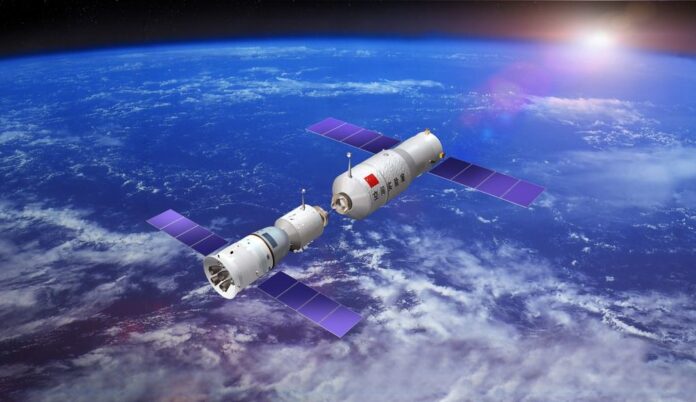
Beijing Tests a One-Year Orbital Stay Inside the Tiangong Station
While Washington continues to multiply spectacular announcements surrounding Artemis and its promised return to the Moon, Beijing moves forward with the cold technocratic discipline that now defines its strategy of power. The China Tiangong mission launched during the night of May 24–25, 2026, is far more than a simple scientific operation. Behind the perfectly staged images broadcast by state television CCTV, behind the carefully calibrated statements from Chinese space authorities, another reality is emerging — one far heavier in geopolitical consequences: China is methodically preparing its complete strategic autonomy in space and, above all, its long-term human presence beyond Earth’s orbit.
A Long March 2-F rocket lifted off from the Gobi Desert, carrying the Shenzhou-23 spacecraft toward the Tiangong space station. Three taikonauts make up the crew: Zhu Yangzhu, Zhang Zhiyuan, and Li Jiaying, the first astronaut from Hong Kong to participate in a Chinese space mission. Yet the real significance lies elsewhere. The core objective of this mission is a discreet but decisive experiment: one of the crew members will remain in orbit for an entire year.
That decision marks a strategic turning point. Behind the official scientific narrative concerning the physiological effects of microgravity, Beijing is in reality validating the operational conditions required for future crewed lunar missions and, eventually, prolonged human activity in deep space.
A Space Mission That Goes Far Beyond Scientific Research
Chinese communication insists on experiments involving life sciences, fluid physics, and space medicine. Yet serious observers quickly understand that this is primarily a full-scale endurance and logistics test.
A one-year orbital mission imposes extreme constraints: continuous air and water recycling, psychological resistance, prolonged exposure to radiation, muscle and bone deterioration, autonomous medical management. In other words, precisely the conditions future lunar bases and Martian ambitions will have to master.
The China Tiangong mission also unfolds within a highly revealing international context. Since the United States banned NASA from cooperating with Beijing in 2011, Chinese authorities have dramatically accelerated their strategy of technological independence. What Washington initially viewed as a way to contain China’s rise ultimately produced the opposite effect: Beijing built its own space station, its own orbital transportation systems, and now openly pursues independent lunar ambitions.
Inside geopolitical circles, several weak signals are beginning to concern American strategists seriously. Unlike many Western programs slowed by political alternation, budget battles, and industrial rivalries, the Chinese space program advances with near-military continuity.
Tiangong Becomes a Symbol of National Power
The decision to keep an astronaut aboard Tiangong for a full year is obviously not accidental. It allows Beijing to demonstrate its capacity for endurance in a field where credibility relies less on political declarations than on operational resilience.
This strategy fits into a far broader vision. By 2030, China intends to land astronauts on the Moon. By 2035, Beijing hopes to establish the first permanent structures of its International Lunar Research Station (ILRS). And unlike many Western narratives increasingly diluted by environmental debates and budgetary hesitation, China still presents space conquest as an openly assumed project of national prestige.
The China Tiangong mission also exposes another reality often minimized across European media: the gradual shift in global technological leadership. In recent years, China achieved several major milestones, including the historic Chang’e-4 landing on the far side of the Moon in 2019 and the successful deployment of a rover on Mars in 2021.
Meanwhile, America’s Artemis program continues to suffer delays, budget overruns, and contradictory announcements. Even financial markets increasingly observe with caution whether the U.S. aerospace industry can truly maintain its timelines.
A Space Rivalry That Foreshadows Tomorrow’s World Order
Beyond technological achievements, China’s rise in space reflects a broader transformation of global power balances. Space conquest is no longer merely scientific territory; it has once again become a direct strategic battlefield between major powers.
China no longer seeks simply to catch up with the United States. It now intends to impose its own infrastructure, technological standards, and geopolitical alliances. The announcement that a Pakistani astronaut will soon join Tiangong perfectly illustrates this parallel space diplomacy.
In this silent confrontation, Europe appears largely marginalized, dependent on American strategic choices while simultaneously watching China’s execution speed with growing concern. As for the United States, official confidence remains publicly intact, yet signs of diplomatic nervousness multiply as Beijing continues accumulating concrete successes.
Tiangong is therefore no longer just an orbital laboratory. It is progressively becoming the symbol of a technological and political confrontation in which China seeks to prove it can compete directly with the West — and perhaps eventually surpass it.
With Shenzhou-23, Beijing is not merely sending three additional taikonauts into orbit. China is validating a crucial step toward future crewed lunar missions and confirming its determination to establish a lasting human presence beyond Earth.
Behind the apparent sobriety of official statements, the message directed at the world is unmistakable: the space power of the 21st century is now being built in Beijing as much as in Washington. And in this strategic competition, every successful mission brings China one step closer to its ultimate objective — imposing its own architecture of power both in space and on Earth.

