


A Colombia on the Edge of a Political Shift
The Colombia Presidential Election 2026 looks less like a conventional democratic transition and more like a brutal referendum on the future of the Colombian state itself. Four years after Gustavo Petro’s historic rise to power, the country appears more fractured, more violent and more unstable than it did in 2022. Behind the official promises of “total peace”, security indicators continue to deteriorate, armed groups are regaining territory, drug trafficking routes are quietly evolving, and foreign investors are watching Bogotá with increasingly visible concern.
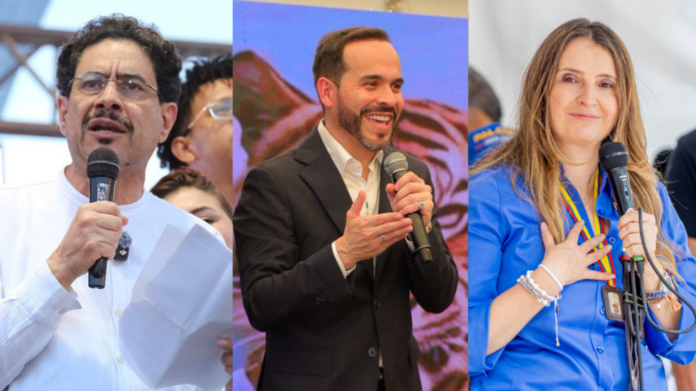
In a campaign where the words “order”, “war”, “elite”, “reforms” and “cartels” dominate public discourse, three figures stand above the rest: Ivan Cepeda, Gustavo Petro’s political heir; Paloma Valencia, the embodiment of the conservative Uribist comeback; and Abelardo de la Espriella, the populist security hardliner openly inspired by Nayib Bukele and Donald Trump.
Behind these candidacies lies a much broader question: will Colombia continue the progressive experiment launched in 2022, or will the country return to a doctrine of uncompromising authority in response to growing insecurity?
Ivan Cepeda, the Methodical Continuation of Petro’s Project
The frontrunner in Colombia’s 2026 presidential election lacks Gustavo Petro’s theatrical style and media-driven confrontations. Ivan Cepeda operates differently: slowly, methodically, almost coldly. And that is precisely what worries part of the Colombian right.
The son of a communist senator assassinated by paramilitary forces in 1994, Cepeda belongs to a political generation shaped by Colombia’s internal violence. Forced into exile in Cuba, Bulgaria and later France, where he studied international humanitarian law, he gradually built an image as an intellectual activist focused on human rights rather than electoral spectacle.
Yet behind this restrained posture stands one of the central political figures of modern Colombia. Founder of the Movement of Victims of State Crimes (Movice), key architect of negotiations with the Farc guerrillas, and senator since 2014, Ivan Cepeda now represents the ideological continuity of the Petro administration: social justice, continuation of economic reforms and ongoing negotiations with armed groups.
His opponents, however, accuse him of embodying a dangerous ideological naïveté in a country where guerrillas, cartels and paramilitary structures continue to thrive. Within Colombia’s security establishment, many believe the strategy of “total peace” merely allowed criminal organizations to quietly reorganize while Bogotá multiplied negotiations with few tangible results.
Cepeda answers these accusations with a moral and social discourse. He denounces what he describes as a “neoliberal model” serving “a small, unproductive elite” and promises to preserve the social achievements of the Petro era, including the historic increase in the minimum wage and expanded social programs introduced since 2022. fileciteturn0file0
In this Colombia Presidential Election 2026, Cepeda therefore appears as the candidate of institutional continuity, but also as the politician who must convince Colombians that permanent dialogue with armed actors can still produce something other than prolonged instability.
Abelardo de la Espriella, Unfiltered Security Populism
If Ivan Cepeda represents ideological continuity on the left, Abelardo de la Espriella embodies the exact opposite: the unapologetic return of raw authority.
At 47 years old, the millionaire lawyer with no political experience has emerged as the most radical figure in the campaign. Impeccable suits, hyper-masculine rhetoric and constant references to Bukele, Milei and Trump — the character is carefully designed to capture the frustration of Colombians exhausted by chronic insecurity.
His political message rests on a simple premise: the Colombian state has lost control of its territory, and only force can restore order. He promises to bomb criminal camps, resume aerial fumigation of coca crops, sink drug-trafficking boats and even shoot down aircraft transporting narcotics out of Colombia.
This radical discourse resonates strongly in regions most affected by cartel violence and guerrilla warfare. Across parts of the Colombian electorate, the perception of a weakened state has fueled growing demands for authority. In some economic circles, there are even signs of renewed support for stronger militarization.
But Abelardo de la Espriella also carries significant controversies. His ties to former paramilitary figures, his past proximity to Alex Saab — regarded by Washington as a key financial operator for Nicolás Maduro — and his deliberately provocative style continue to generate concern alongside enthusiasm.
The candidate nevertheless embraces this political brutality. During rallies, he repeatedly promises to govern with an “iron fist”. Behind the slogan, many observers see the Latin American version of a broader global trend: the return of security-driven democracies where public order increasingly outweighs legal ambiguity.
Paloma Valencia, the Disciplined Return of Uribism
Long considered an outsider in the race, Paloma Valencia has gradually become the most credible option for a traditional right-wing electorate seeking to regain power without embracing outright populist excess.
Granddaughter of former president Guillermo León Valencia and political protégé of Álvaro Uribe, she represents the continuation of the conservative current that dominated Colombian politics for much of the last two decades. After the assassination of right-wing candidate Miguel Uribe in 2025, she inherited the leadership of a movement deeply shaken by the return of political violence.
Her message is direct: end Gustavo Petro’s “total peace” strategy and impose what she calls “total security”. Unlike Cepeda, she argues that negotiations with armed groups have projected weakness. Unlike De la Espriella, however, she seeks to maintain an institutional image compatible with Colombia’s traditional diplomatic and economic balances.
Paloma Valencia also openly defends liberal economic policies, including support for hydraulic fracturing and energy investment expansion. On social issues, she remains aligned with conservative positions, opposing broader abortion rights and criticizing several LGBT+ policy developments.
Her decision to choose Juan Daniel Oviedo — the first openly gay vice-presidential candidate on a Colombian presidential ticket — nevertheless reflects an attempt to modernize the image of Uribist conservatism and reassure urban voters as well as international partners increasingly uneasy with the radicalization of Colombian politics.
A Colombian Election Under Maximum Security Tension
What stands out most in this campaign, beyond the slogans, is the country’s atmosphere itself. Temporary closures of rural regions, growing armed attacks, renewed cartel activity and rising tensions near border zones all contribute to the feeling that Colombia may be drifting back toward dynamics many believed belonged to the 1990s.
Washington officially supports Colombia’s democratic process, yet signals from American security circles remain noticeably ambiguous. The United States appears cautious about a potential Cepeda victory while simultaneously wary of the diplomatic consequences of an aggressively security-focused presidency under De la Espriella.
Regional financial markets are already showing signs of nervousness regarding Colombian assets. Energy security, export stability and military relations with the United States could quickly become central geopolitical issues depending on the election outcome.
The Colombia Presidential Election 2026 therefore extends far beyond Colombia’s borders. This vote may shape the broader ideological balance of Latin America itself, between the resurgence of security-driven conservatism and the survival of progressive political experiments.
An Election That Will Define Colombia’s Future
Rarely has a Colombian presidential election reflected such a complete confrontation between three irreconcilable visions of the country.
Ivan Cepeda promises the continuation of social reforms and negotiations with armed groups. Paloma Valencia advocates a return to a structured conservative right centered on state authority. Abelardo de la Espriella channels the security-driven anger of a population increasingly willing to accept extreme methods in exchange for restored order.
In a Colombia exhausted by violence, narcotrafficking and social fragmentation, this election could permanently reshape the political balance of Latin America. And behind the official rhetoric about democracy and stability, many already understand that regardless of who wins, the country will remain deeply divided.

