


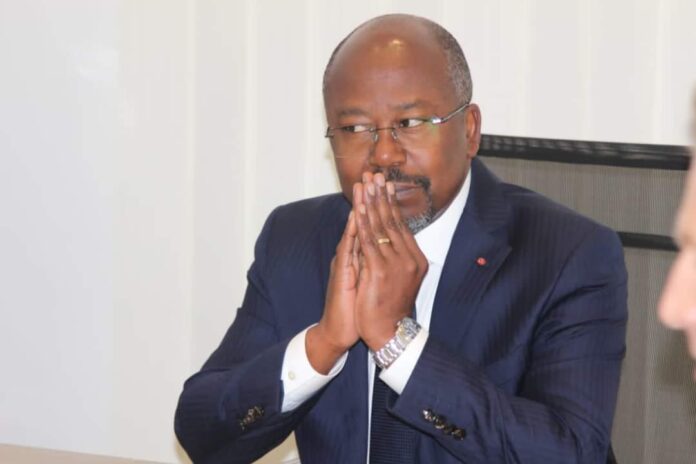
A judicial move… or a political warning?
The Gabon opposition arrest of Alain-Claude Bilie-By-Nze, now placed under a detention order, lands like a dull but unmistakable blow in an already tense political climate. Officially, Libreville speaks the language of legality — “fraud” and “breach of trust,” a dispute over 5 million FCFA dating back to 2008 — yet the timing, almost surgical, raises questions that no communiqué can fully contain.
Because in Gabon today, nothing happens in a vacuum. And certainly not the incarceration of a former Prime Minister turned principal opposition figure.
Gabon opposition arrest exposes deeper fractures
It is difficult to ignore the sequence of events. Just weeks after openly challenging government measures — from the suspension of social networks to the controversial reform of nationality laws — Bilie-By-Nze is arrested at his home, then swiftly detained.
A coincidence, we are told.
Yet, in regimes where institutional balance is fragile, coincidence often wears the mask of convenience.
The prosecution insists on judicial independence. A familiar refrain, repeated across continents whenever political opponents suddenly find themselves entangled in long-dormant legal cases. The alleged debt, linked to a cultural event organized under state authority nearly two decades ago, appears less like an urgent criminal matter than a resurrected file — selectively exhumed.
A climate of controlled dissent
The broader context matters. President Brice Oligui Nguema, elected with an overwhelming 94.75% of the vote — a figure that in itself invites skepticism — now faces growing social unrest. Teachers on strike, simmering dissatisfaction, and a tightening grip on public expression.
The suspension of social media since February did not go unnoticed. Nor did the new nationality law, which introduces the possibility of stripping citizenship for vaguely defined “subversive activities.” In other words: dissent, rebranded as destabilization.
Within this framework, the Gabon opposition arrest begins to resemble less an isolated judicial act and more a signal — a calibrated message to anyone tempted to challenge the prevailing order.
The familiar mechanics of power
Bilie-By-Nze’s party, Ensemble pour le Gabon, denounces a “serious political maneuver.” Predictable, perhaps — but not necessarily unfounded.
There is a pattern here, one that seasoned observers of African and, more broadly, post-colonial political systems will recognize:
- revive an old financial dispute,
- personalize institutional responsibility,
- isolate the opponent,
- let the judiciary formalize what politics initiated.
What is striking is not the method — it is almost textbook — but the context in which it unfolds. Gabon, long presented as relatively stable, now shows signs of a more assertive, even defensive, consolidation of power.
Between sovereignty and suspicion
One must also read this episode through a wider geopolitical lens. African governments, increasingly wary of external pressures — particularly from Western capitals quick to lecture on democracy — often harden internally while asserting sovereignty externally.
Yet this balancing act is delicate. The more authority is centralized, the more legitimacy becomes contested.
And here lies the paradox: in attempting to silence dissent in the name of stability, regimes risk amplifying the very instability they seek to avoid.
A test for Gabon’s political trajectory
The detention of Alain-Claude Bilie-By-Nze is not just a legal episode; it is a moment of truth for Gabon.
Either the authorities demonstrate, transparently and convincingly, that this case is purely judicial — and withstand the scrutiny that will inevitably follow — or it will be remembered as another step in the gradual erosion of political pluralism.
In the quiet corridors of power, such decisions are often seen as tactical.
History, however, tends to judge them as turning points.

