


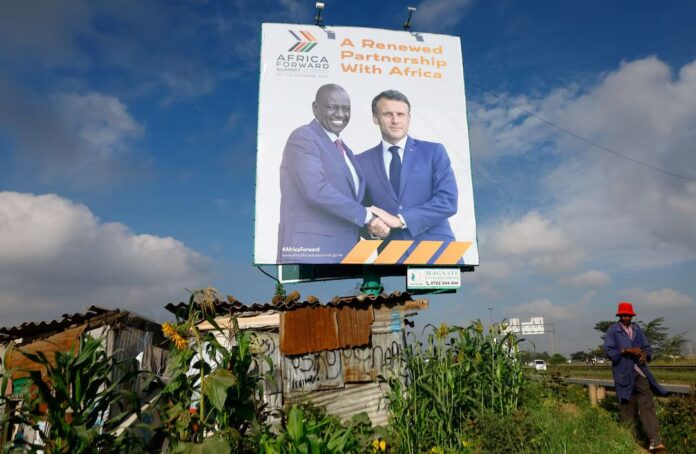
An Economic Summit That Barely Hides the Influence War
In Nairobi, the Africa Forward summit was never merely a diplomatic showcase between Paris and several African capitals. Behind the carefully staged handshakes and the billions of euros announced with theatrical precision lies a far harsher reality: a rapidly intensifying international struggle for economic influence across Africa. Inside the corridors of the University of Nairobi, where industrialists, investors and government representatives moved from meeting to meeting, everyone appeared to understand one thing clearly — Africa is no longer a future market. It is already the strategic battlefield of the 21st century.
The contrast was striking throughout the day. While French officials insisted on speaking about “balanced partnerships,” the entrepreneurs and investors attending the forum discussed something far more concrete: contracts, market access, infrastructure financing and strategic positioning against Chinese, Turkish and Gulf competitors. Their language was direct, pragmatic and revealing. It exposed the summit’s real purpose far more honestly than the official speeches.
Africa Forward: Paris Attempts to Rebuild Its Economic Position
French Foreign Minister opened the summit by announcing more than one billion dollars in bilateral contracts between France and Kenya across transportation, energy, trade and healthcare sectors. A few hours later, and unveiled a broader €23 billion investment package combining French public and private funding with African capital.
Officially, these announcements were meant to symbolize a “new partnership” between France and Africa. Yet behind closed doors, many participants quietly admitted that France is above all attempting to recover lost ground on a continent where its influence has weakened considerably in recent years, particularly in West Africa. The choice of Kenya — politically stable, economically ambitious and regionally influential — was therefore anything but accidental.
Inside the business forum itself, this repositioning strategy was impossible to ignore. French companies rarely spoke about cultural cooperation or historical ties. Instead, discussions revolved around market share, public tenders and long-term access to strategic sectors.
French Companies Search for New Markets
The business forum organized under the umbrella of Africa Forward gathered thousands of African and French economic actors. Commercial representatives, investors and business executives filled the university campus, navigating crowded thematic spaces in search of opportunities and influential contacts.
Among them was Adil Sarhiri, export manager for Metalu Plast, France’s leading manufacturer of sports equipment, who openly acknowledged the scale of the competition unfolding around him.
“There are a lot of people here and it is not always easy to understand who does what,” he explained, visibly struck by the density of the economic ecosystem now forming around African development projects.
The French company hopes to expand aggressively across the continent, particularly in sports infrastructure. Kenya represents a strategic market, especially with the 2027 Africa Cup of Nations approaching, which the country will co-host alongside Tanzania and Uganda.
Behind projects like these, a broader reality is becoming increasingly obvious: European companies understand that securing African public contracts now requires positioning themselves years in advance. The real competition often takes place long before official tenders are launched, inside networking forums where political relationships and personal trust quietly shape future deals.
Economic Diplomacy Has Become a Geopolitical Weapon
What stood out most in Nairobi was the omnipresence of French public institutions dedicated to supporting national companies abroad. , a partner of the summit, organized rapid networking sessions between African entrepreneurs and European investors.
This form of economic “speed dating” increasingly resembles a parallel diplomatic apparatus. The French state now openly acts as a commercial facilitator in what has become a direct strategy of economic power projection. It also reflects a deeper reality: traditional diplomatic narratives carry far less weight today, forcing states to defend their industrial and strategic interests much more openly.
Within these networking sessions, Kenyan entrepreneur Christine Ouma, founder of the start-up Digit-All, searched primarily for financial partners capable of accelerating technological solutions for visually impaired and deaf individuals.
Her discourse sharply contrasted with the rhetoric of multinational corporations. While major groups focused on investment volumes and infrastructure projects, she spoke about the lack of accessible technological solutions and the persistent difficulty African innovators face in securing affordable financing.
Africa Forward Reveals Africa’s Financial Vulnerabilities
Beyond the spectacular investment announcements, Africa Forward also exposed a much deeper structural issue: the cost of financing across Africa.
Rahul Salhotra, representative of the French construction financing company Ultimat, described the situation bluntly. According to him, many African companies remain trapped by extremely high borrowing costs because international investors continue to classify African markets as inherently risky.
This reality partly explains why foreign powers are competing so aggressively to control the continent’s financing mechanisms. Those who finance infrastructure projects often gain significant indirect influence over economic priorities — and sometimes even political orientations.
Behind the official language of equal partnerships, several African entrepreneurs attending the summit privately expressed skepticism toward the grand promises repeatedly announced by international powers. Many have witnessed previous summits filled with ambitious declarations that produced only limited concrete outcomes on the ground.
Africa Has Become the Center of Global Economic Rivalries
The Nairobi summit confirmed a transformation that is now impossible to deny: Africa has once again become a central arena in global economic competition. China continues to consolidate infrastructure networks, Turkey expands commercial agreements, Gulf monarchies invest heavily in ports, agriculture and energy projects, while European powers struggle to preserve their historical influence.
Within this environment, France appears to be searching for a new strategic momentum. But the balance of power has changed profoundly. African governments now negotiate with greater confidence, deliberately place foreign powers into competition and increasingly demand immediate and measurable economic benefits.
In Nairobi, behind the diplomatic smiles and carefully calibrated press releases, everyone seemed to understand the same underlying truth: the economic battle for Africa is only beginning. And in this silent geopolitical contest, only those capable of delivering rapid financing, concrete infrastructure and reliable political guarantees will maintain lasting influence.

