


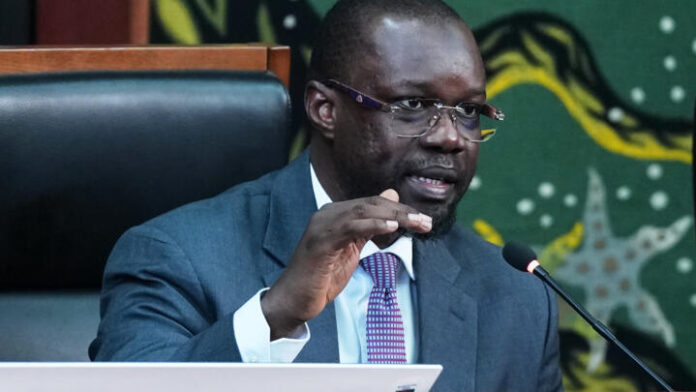
Senegal has likely crossed a political threshold that Dakar was still trying, until recently, to conceal behind the rhetoric of unity following Pastef’s rise to power. With the announcement of a new government by President Bassirou Diomaye Faye — despite the boycott declared by Ousmane Sonko — the Senegalese leadership is now openly displaying fractures that Western diplomats had carefully downplayed for months.
Behind the polished statements and institutional language lies a far more serious reality: an escalating struggle for influence at the very heart of the state.
Only twelve days after Sonko was dismissed as Prime Minister, the former opposition firebrand — now President of the National Assembly — has chosen confrontation. And in a country already weakened by severe financial instability, such tensions at the top of government are anything but symbolic.
Ousmane Sonko Boycotts Government Over Deepening Rift with Diomaye Faye
Officially, the disagreement concerns “the place and role of the majority within the executive structure.” The wording sounds deliberately vague, almost administrative, but it conceals a much deeper conflict: the coexistence between Bassirou Diomaye Faye and Ousmane Sonko increasingly appears politically unsustainable.
For months, subtle warning signs had accumulated. Separate public appearances. Diverging tones on economic policy. Ambiguity surrounding negotiations with the IMF. And above all, a growing determination inside the presidency to regain control over the machinery of state while Sonko’s popular influence continued to overshadow the formal institutions.
The newly unveiled Senegalese government illustrates this contradiction almost perfectly. Pastef officially announced it would not participate in the executive branch — yet several party figures and close allies remain in strategic ministerial positions.
Moussa Bala Fofana retains the Urban Planning portfolio, while Yankhoba Diémé takes charge of the Armed Forces Ministry. Politically, the situation borders on incoherence, revealing less a coherent strategy than an unresolved balance of power between two rival centers of authority.
Because in Senegal, many still believe that Ousmane Sonko remains the true political force behind the ruling movement, regardless of his removal from government.
A Political Crisis Emerging Amid Financial Fragility
The timing of this crisis is far from accidental. Senegal is currently navigating a major economic storm following revelations that the previous administration significantly underreported public debt levels.
Debt is now estimated at 132% of GDP by the end of 2024, according to figures circulating during discussions with the International Monetary Fund. The IMF has suspended its $1.8 billion loan program, placing enormous pressure on Dakar just weeks before critical negotiations resume.
In this context, political instability immediately becomes a financial risk.
Investors pay less attention to official speeches than to real power dynamics. And seeing the historical leader of Pastef publicly refuse participation in the government sends a deeply negative signal to international lenders and financial markets.
Even more striking, some political observers in Dakar are beginning to describe the emergence of two competing legitimacies: the institutional legitimacy embodied by President Diomaye Faye, and the popular legitimacy still overwhelmingly controlled by Sonko.
Senegal Risks Sliding Toward Dual Power
Perhaps the most revealing aspect of this crisis is the cautious silence of Western capitals. Washington, Paris, and Brussels are watching developments in Senegal with growing unease, particularly as the country has long been presented as one of West Africa’s last democratic anchors.
But behind diplomatic restraint lies genuine concern: the possibility of a divided leadership unable to choose between institutional governance and militant political pressure.
The danger now is one of slow paralysis. A president officially in power. A party leader retaining immense grassroots authority. And a state administration trapped between two competing centers of decision-making.
Inside Senegal’s political circles, some already speak of a “cold cohabitation.” Others describe it more bluntly as the beginning of a political divorce.
Either way, Senegal is entering a phase where every ministerial appointment, every IMF negotiation, and every presidential appearance will now be interpreted through the lens of this widening fracture between Bassirou Diomaye Faye and Ousmane Sonko.
And in a Sahel region already destabilized by coups, sovereignist tensions, and growing distrust toward Western influence, this internal Senegalese crisis may rapidly evolve into something far larger than a domestic political dispute.
The government boycott led by Ousmane Sonko likely marks the end of the illusion of complete unity at the top of the Senegalese state. Beneath the institutional façade, an open struggle for influence is now unfolding between the two dominant figures of power.
And at the very moment Dakar must reassure creditors, stabilize public finances, and preserve domestic order, this political fracture could become Senegal’s greatest vulnerability.

