


A Russian drone crashes in Romania and exposes a dangerous strategic shift
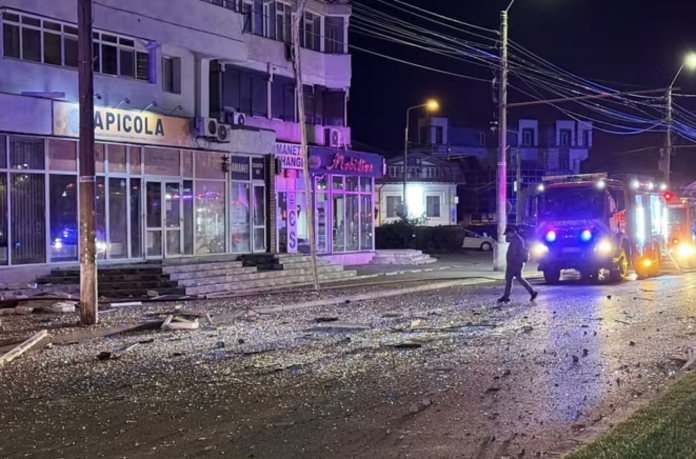
The sequence matters far more than Western officials currently admit. A Russian drone in Romania struck a residential building overnight in the city of Galați, only a few kilometers from the Ukrainian border, triggering a fire and injuring two civilians. Bucharest immediately described the incident as a “serious and irresponsible escalation.” Yet behind the diplomatic language lies a far more unsettling reality: Moscow appears to be methodically testing the psychological and military limits of NATO’s eastern flank.
For months, Russian drone incursions into Romanian airspace had been dismissed as technical mishaps, unfortunate side effects of a war unfolding nearby. This time, the threshold has changed. A Russian drone did not merely drift off course — it reached and struck a civilian residential building inside a NATO member state. And despite the emergency deployment of Romanian F-16 fighter jets, the drone was not intercepted.
That single fact may ultimately matter more than all the official statements released afterward.
Russian drone Romania incident exposes NATO’s vulnerabilities
Romania’s Ministry of Defense confirmed that the drone was tracked by radar until it impacted the roof of the apartment building in Galați. Two F-16s were scrambled from Fetesti Air Base and were reportedly authorized to engage the target throughout the alert period. Yet no interception occurred.
This contradiction reveals an increasingly uncomfortable truth for NATO planners.
Low-cost drones are gradually exposing the structural weaknesses of Western air defense systems. Fighter jets designed for conventional state-on-state warfare are poorly adapted to slow-moving, erratic, expendable aerial platforms capable of overwhelming detection and interception systems at minimal cost.
Romania is now urgently requesting additional anti-drone capabilities from its allies. Implicitly, however, that request confirms something NATO officials rarely acknowledge publicly: despite years of declarations about “European strategic readiness,” the Alliance’s eastern frontier remains dangerously exposed.
Moscow thrives on strategic ambiguity
The Kremlin has not formally claimed responsibility for the strike. Predictably so.
Russia increasingly operates within a zone of calculated ambiguity, blurring the line between accident and deliberate provocation. It is a familiar doctrine: push just below the threshold that would trigger direct escalation while steadily normalizing increasingly aggressive behavior.
Recent Russian signals suggest this strategy is intensifying. Moscow has warned foreign nationals and diplomatic personnel to leave Kyiv ahead of potential large-scale bombardments. Simultaneously, Russian attacks against Ukraine have reached some of their highest levels since the war began, involving hundreds of drones and dozens of missiles in coordinated assaults.
European governments still describe these incidents as isolated “spillovers” from the Ukrainian conflict. Yet the repetition itself changes the nature of the threat. What was once presented as accidental is gradually becoming structurally predictable.
Romania and the Baltics increasingly understand the war is already spreading
Romania is no longer a peripheral observer to the war in Ukraine. Like Poland and the Baltic states, it is becoming part of a gray-zone confrontation where the boundaries between conventional warfare, technological intimidation, and psychological pressure are steadily dissolving.
The most revealing aspect may be the widening gap between Western rhetoric and operational reality. Brussels speaks constantly about strengthening European security architecture, yet repeated drone incursions continue to expose severe shortcomings in regional air defense capabilities.
Even the states most directly threatened remain heavily dependent on American systems, American logistics, and ultimately American political decisions.
And beneath that dependency lies a question European leaders still avoid confronting openly: how far is Washington truly prepared to go if Russian provocations against NATO territory become routine rather than exceptional?
A slow but deliberate escalation
The Galați incident may represent less a military turning point than a psychological one. Moscow appears intent on normalizing the idea that NATO territory can be struck intermittently without provoking a decisive response.
That is often how red lines disappear — not through dramatic confrontation, but through repeated incidents that gradually become familiar enough to tolerate.
While European officials continue speaking the language of “regional stability,” the war itself keeps advancing quietly along the eastern edges of the continent, one calibrated escalation at a time.

